
FinTech Scotland’s first anniversary heralds a growing fintech economy across Scotland
FinTech Scotland has confirmed that the number of innovative fintech SMEs based in Scotland has grown by three times to over eighty in the last twelve months.
The announcement comes on the first anniversary since the formation of FinTech Scotland, a joint initiative by a number of financial services firms, University of Edinburgh and Scottish Government.
The growth in the new fintech enterprises focused on reinventing financial services has been driven by both new start-ups and existing fintech firms moving to Scotland.
In addition, the number has also been bolstered by early stage Scottish technology firms expanding their proposition into financial services.
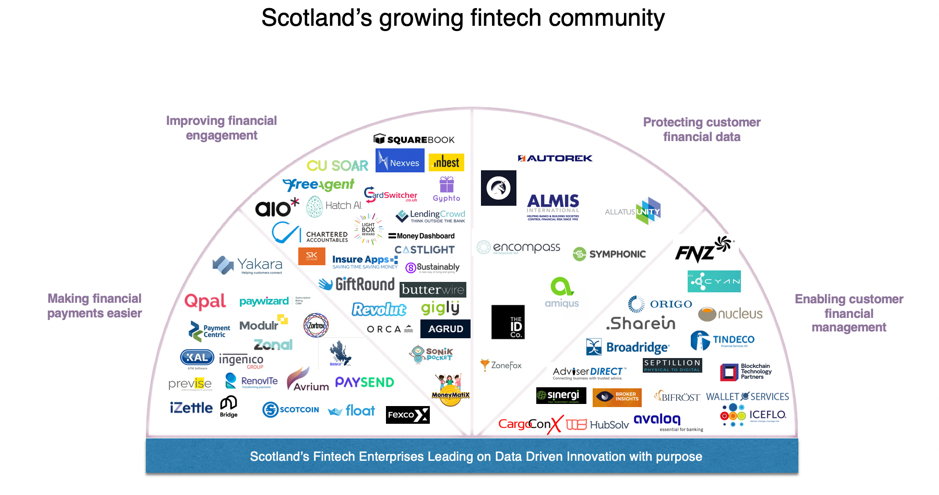
Since its inception FinTech Scotland has facilitated the growing fintech innovation by fostering the connection between entrepreneurs, large financial services firms, the universities, Government and public sector as well as a range of strategic stakeholders.
Examples of FinTech Scotland’s strategic enabling role have included:
- Developed fintech access to funding and business services with the appointment of a fintech commercial partner Vivolution in conjunction with Scottish Enterprise
- Connected fintech firms with over a dozen large financial services firms and members of Scottish Financial Enterprise to develop new routes to market
- Collaborated with Scottish Development International and Deloitte to develop global connections in Far East, Europe and USA for inward investment and exporting
- Supported the development of fintech entrepreneurial networks and accelerators hubs such as the University of Strathclyde Technology and Innovation Centre
- Developed fintech skills with Scotland’s universities, colleges such as Fife Fintech Skills Academy and student groups such as Glasgow University FinTech Society
- Close collaboration with the Financial Conduct Authority to support fintech firms regulatory understanding reinforced by a senior secondment to FinTech Scotland
- Grew the visibility of the Scotland’s fintech activity through the launch of new digital platformand over 80 fintech events including the FinTech Festival with Visit Scotland
- Developed financial inclusion and diversity initiatives working with consumer groups, social enterprises and bodies such as Equate Scotland
- Facilitated cross sector fintech innovation, for example, with Law Society of Scotland and Scotland IS Cyber team as well as Scottish Government and the CivTech initiative
Digital Economy Minister, Kate Forbes said: “Congratulations to FinTech Scotland for an immensely successful year. With Stephen Ingledew at the helm, FinTech Scotland has galvanised collaboration between Scotland’s universities, financial industry and public sector. Together, we are building Scotland’s reputation as a major global FinTech centre. I personally commend FinTech Scotland for their hard work last year and their vision for the future.
Commenting on the first year Stephen Ingledew, Chief Executive of Fintech Scotland said: “It has been a privilege over this last twelve months to lead the FinTech Scotland team and galvanise the broad range of support from across Scotland to support the growth of innovative fintech enterprises in this last year.
Our progressive, collaborative and inclusive agenda is certainly establishing Scotland as a major global fintech centre which can contribute to Scotland’s economic and social ambitions.
One year on there is still much to do but with a very supportive Board and strategic partners plus a range of stakeholders from private sector, Government and academia actively participating we can achieve the top ranking global fintech status “
Graeme Jones, Scottish Financial Enterprise Chief Executive, said: “FinTech Scotland has made a significant impact over the past 12 months by raising awareness of Scotland’s fintech capabilities and the opportunities available for new and existing businesses. Scotland’s financial services industry has always been at the forefront of innovation and I’m pleased to see this momentum continue. SFE and our members will continue to work collaboratively to support Stephen and his team as they strive to make Scotland a global fintech leader.”
The first anniversary was recognised on Tuesday the 8thof January at the Financial Services Advisory Board (FiSAB) meeting held at the University of Edinburgh, one of the founding partners of FinTech Scotland.
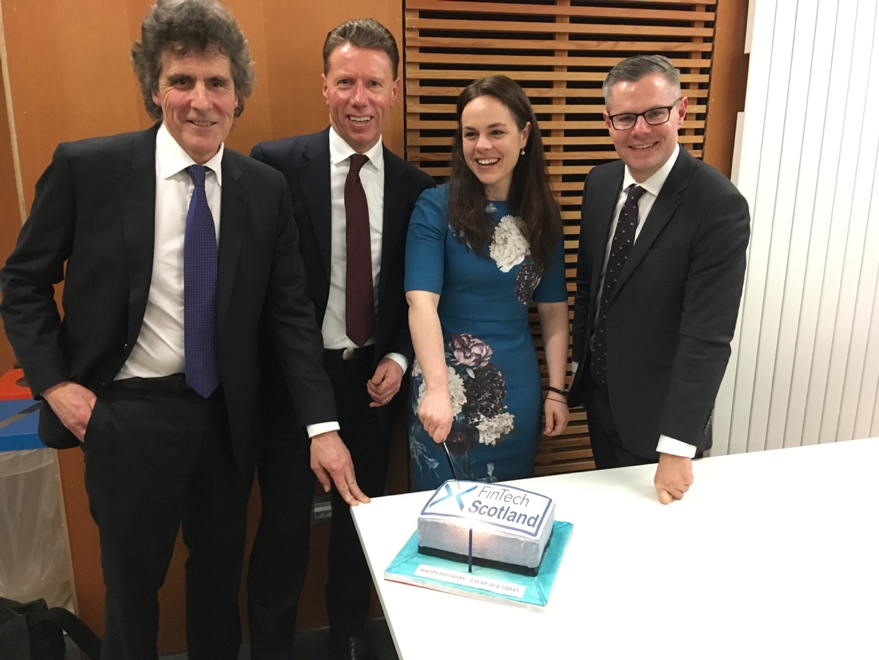
Picture taken at FiSAB on 8 January 2019.
Economy Secretary, Derek MacKay, Digital Economy Minister, Kate Forbes, Jim Pettigrew, FiSAB Co-Chair and Chairman of CYBG plc, Stephen Ingledew, Chief Executive, FinTech Scotland.
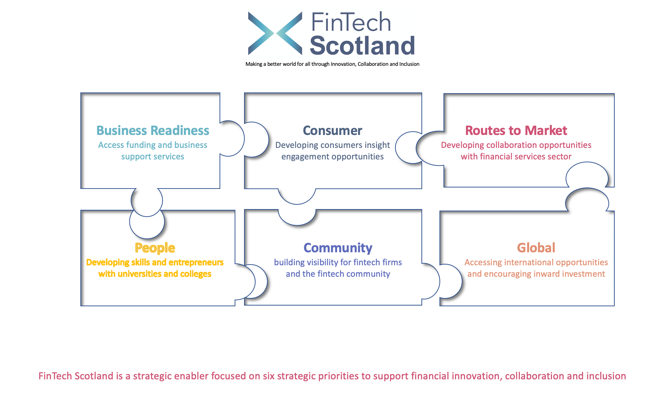
At the FiSAB meeting, Stephen Ingledew outlined the key priorities for FinTech Scotland in 2019:
Would your business benefit from an in-depth piece of research and analysis?
The University of Edinburgh is currently looking for projects for MSc Business Analytics, MSc Banking and Risk, and MSc Finance.
Their students are among the best in their field and combine their strategic business and management skills and specialist knowledge with the refinement offered through our 12-month, intensive programmes. They offer different types of projects and will match you with an individual postgraduate student with the specialised skill set suited to your research needs.
The University of Edinburgh MSc in Finance covers all aspects of investment, corporate and energy finance. MSc Banking & Risk projects could cover such topics as analysis of corporate financial information, credit risk management, econometrics applications and many others.
They University can consider almost any topic that has a finance, accounting, investment, energy market, banking or risk focus. Successful projects tend to have an empirical element, which has practical relevance. Most students are keen to work with practitioners on projects which will be of real value to them, helping them find solutions to strategic financial issues such as validity forecasting, forecast asset market returns, risk modelling, dynamic lifecycle strategies etc.
The MSc in Business Analytics (recently ranked 9th in the world in the QS Global Business Masters ranking) is designed to train analysts capable of taking on complex challenges and getting them industry-ready. The programme prepares students not only to be able to analyse and digest data available, but also to translate this into effective decision-making.
A key part is a research-based dissertation project. They are particularly interested in dissertation topics in optimisation or data science. Can you help?
If so, the University is looking for companies to submit project ideas by 26 January 2019. In return, you’ll benefit from the insight of one of the high-calibre postgraduate students, including a substantial report featuring extensive research, rigorous analysis and practical conclusions. To find out more, visit Sponsored Dissertations
To discuss further, contact Ksenia Siedlecka, Business Development Manager, ksenia.siedlecka@ei.ed.ac.uk for MSc Business Analytics
or
Aidan Hetherington, Corporate Engagement Manager aidan.hetherington@ed.ac.uk for MSc Banking and Risk and MSc Finance
2018 in Review & Orca’s Big Plans for 2019
2018 has been a big year for Orca. We launched the Orca Investment Platform, secured another funding round, and expanded the business in personnel and location. Not to mention, plans have been put in place for the launch of the Orca ISA and the Self-Select’ portfolio builder, a complementary product to the existing Model’ portfolio.
Here is our 2018 timeline of significant milestones”¦
February 2018 – Orca Investment Platform Launches
In February, we launched the Orca Investment Platform, an aggregator which integrates with multiple major peer to peer lenders, enabling investors to spread their capital and risk across platforms, sectors, and borrowers.
This was a massive moment for Orca. Years had been spent building up to this point and a tremendous amount of effort had been invested by many, many people. Special thanks to those who supported us, you know who you are.
September 2018 ”“ Seedrs Equity Crowdfunding Campaign Launches
We ran our first ever equity crowdfunding campaign. Using the Seedrs platform and admittedly unsure of how successful the campaign would be, we were delighted to exceed our £500,000 target in under two days!
With more than 400 investors, spanning dozens of countries, the response from the crowd ”“ including Orca users ”“ has been an especially rewarding feature of the year.
December 2018 ”“ Orca Secures Over £500,000 in Equity Funding
Following the close of the Seedrs campaign, and with contribution from venture capital funds, angel networks and private investors, Orca secured £574,280.
The funds will contribute to Orca’s development and growth plans for 2019.
Now, 2019, here’s the big pitch”¦
Q1 2019 ”“ Orca ISA
The Orca ISA will be a first of its kind in the market where investors can build their own portfolio and hold it in an ISA. Current ISA rules stipulate that people can divide their tax-year ISA allowance of £20,000 between ISA (e.g, Cash, Stocks & Shares and Innovative Finance ISA) accounts however they wish. But, they may only subscribe current tax-year subscriptions to a single IF ISA each year. This means it is very difficult to build a diversified P2P portfolio which is wrapped in an ISA. Investors typically hold one P2P investment within an IF ISA, while the remaining P2P investments are held in taxable general investment accounts.
With the Orca ISA, investors can hold multiple P2P providers in a single IF ISA. Here are the key benefits:
- Invest in the Orca Model portfolio suitable for hands-off investors or Orca’s Self-Select portfolio for the more active investor
- Earn interest up to 6.5%
- Earn returns tax-free
- Diversify ISA money across multiple P2P providers
- Transfer old ISA money
- Invest ISA money at non-ISA P2P providers
The company is already building a Wait List of investors eagerly awaiting the launch of the ISA.
Q1 2019 ”“ Self-Select Portfolio Builder
In addition to the launch of the Orca ISA, we are also launching a new product to complement the existing Model portfolio product.
The Self-Select portfolio builder allows investors to implement their own strategies, selecting only the P2P providers and products they wish to hold in their portfolio. What’s more, investors can build their portfolio and hold it in the Orca ISA.
2019 ”“ Integrate New Lenders
Throughout 2019 we’ll be seeking to introduce new lenders to the aggregator, offering investors greater choice and diversification. Updates on this will come in the new year.
2019 ”“ On-board EU Investors
We are investigating how we can on-board EU investors, something which we believe will stimulate growth in the UK P2P market and offer EU investors a simple access-point to UK P2P lending.
To find out more about our exciting new product developments, click here
Finally, a special thanks to everyone who has invested with Orca, your support is very much appreciated; the value early adopters offer businesses is immeasurable and helps shape future product iterations, so thank you from the entire Orca Team. Have a fantastic 2019!
Applied Fintech Project – Final Event and last update
Blog written by Elisabetta Trasatti, Vice President at UoG FinTech Society
Last Friday night, an entertaining final event at the Glasgow University Union concluded the first Applied FinTech Project (AFTP), organised by the UoG FinTech Society.
Almost one hundred people, including students, professionals and academics, attended the event. With two keynote speakers, a buffet dinner, and the UofG Jazz band playing throughout the evening, the project could not come to an end in a more successful way. In the words of one of the AFTP mentors,
“the event was very well organised: great location, very good and fitting music, and a great jury.”
In case you are hearing about the Applied FinTech Project for the first time, here is a quick run through the ideas and aims of the project.
The AFTP has been designed as an experiential learning opportunity for students, who got the chance to work in teams on a hands-on FinTech case over the course of four weeks.
The project was launched in September with an Information Session at the University and immediately gained the attention of students from different degree subjects and years of study. When reviewing applications, the UoG FinTech Society board was immediately impressed by their quality. Applicants ranged from Computer Science to Engineering, to Economics, Philosophy, Business and Psychology students, and all showed great interest in FinTech, as well as a strong desire to develop their team working and communication skills.
The 25 selected participants, both Undergraduate and Postgraduate students, were divided into 5 teams and given a case provided by the startup Orca Money regarding its expansion strategy in the EU. The teams also got the chance to participate in a workshop organised specifically for them by Deloitte and were assigned a mentor to guide them throughout the project. The mentors, working at Previse, Castlight Financial, Deloitte and Morgan Stanley, both communicated with the teams via email and met with them in person, in order to talk through the challenges the students were facing in their research and give them useful advice.
Last Friday, the teams’ presentations clearly showed all the hard work and dedication that each one of them had put into the project. Not only they presented their findings, but also produced a detailed written report which the judges could read through to get a better understanding of their solutions. As with the mentors, the UoG FinTech Society could not be prouder of having such a great board of judges, of both academics and professionals, participating in the final event.
Another tremendous feature of the evening was the chance for attendees to hear two inspiring keynote speakers. Stephen Ingledew, CEO at FinTech Scotland and Keith O’Donnell, Technology Innovation Lead at Morgan Stanley, provided insights into the Scottish FinTech ecosystem, the current and future trends in FinTech and the ways in which large companies like Morgan Stanley are encouraging innovation in this sector.
The project participants all seemed to enjoy the event and provided positive feedback also regarding the case, their respective mentor and the overall experience they got from participating in the AFTP. As one of the participants stated,
“it doesn’t happen every day to have people say Hey, I worked on an EU expansion strategy for startup X during my second year of university!’ (Imagine saying this in an interview!).”
As it has proved to be such an enriching experience for the students involved, the UoG
FinTech Society hopes to see the Applied Fintech Project become an established society tradition for the years to come. Reaching and involving even more students in the project is one of the society’s main aims, for which the students’ feedback is shaping up to represent a very effective marketing tool:
“How to absorb business knowledge, make new friends and communicate with industry experts in one month? Join the AFTP!”.
Fintech Workshop – trading internationally
-
Market analysis
-
Market entry
-
How to sell online internationally
-
An insight into opportunities in Germany and The Netherlands
-
One-to-one support from SDI’s experts on key areas including trading internationally and digital marketing
-
Plus, it’s the ideal setting to network with other like-minded Scottish businesses
Fintech onboarding guidelines by UK’s 5 largest banks
The importance of technology for Scottish growth
-
How to deal with data protection issues as an SME – Alastair McKendrick, TC Young Solicitors.
-
How Healthy Nibbles gained competitive advantage through innovation in a traditionally non tech sector – Sara Roberts, founder Healthy Nibbles.
-
The practical applications of emerging tech in business – David Sime, Oncor
-
Making tax digital – hate it or embrace it – Mandy Bogot, Gillespie’s Chartered Accountants
-
Accessing support and expertise for your business at The University of Edinburgh – Sara Robertson, Entrepreneurship Development Manager, The University of Edinburgh
-
Outsourcing IT services – how to do it right? – Michal Sztanga, Future Processing
-
After the sale; a quick guide to getting paid and staying legal – Matt Perkins, Freeagent
Ethical Finance 2018: Regaining Trust and Demonstrating Impact
Growing awareness of UNSDGs, sustainability, climate change and social justice issues, combined with concerns around trust arising from the 2008 financial crisis, have raised questions around the integrity, transparency and accountability of financial institutions and driven consumer expectation for finance to be social cognisant.
UKIFC in partnership with Responsible-Investor.com present a brand new conference, titled Ethical Finance 2018’ in Edinburgh on October 22-23, hosted by RBS and supported by the Scottish Government, HM Government and UNDP.
The aim of the conference is to gather banks, asset managers, faith-related investors, mission-driven endowments, charities and family offices together to look at practical solutions to promote trust in banking and investment and create long-term, sustainable finance solutions.
It will explore how trust in a sustainable economy can be revitalised, and how faith and endowment investors are confronting today’s biggest societal and economic challenges, notably as part of the United Nations Sustainable Development Goals (SDGs).
Topics on the agenda include:
· How do endowments, family offices and philanthropic entities use values and purpose as investment strategies
· How are faith groups ensuring their assets are managed according to the purpose
· The UN Sustainable Development Goals and the practicalities of investing
· Measuring impact across different asset classes
· The move from negative screening to positive investment
· Direct impact investing in developed and emerging markets.
The event will include a reception at Edinburgh Castle hosted by the Scottish Government.
The programme for the conference and further information can be found on the event site and by clicking for the programme and further info via the Register button.
A journey through the FCA regulatory sandbox
The Financial Conduct Authority (FCA)’s regulatory sandbox has now been in place for two years, and has continued to draw in innovative firms keen to test their business models, products and services in the market.
The FinTech team in Deloitte’s EMEA Centre for Regulatory Strategy, in collaboration with Innovate Finance, interviewed several current and previous FCA sandbox participants to seek their views on their sandbox journeys.
The result is A journey through the FCA regulatory sandbox: the benefits, challenges, and next steps.
It highlights the key themes, challenges, unexpected benefits and broader observations that firms expressed in relation to their sandbox journey, including their views of what the FCA’s next steps should be.
The unequivocal message is that the FCA sandbox has delivered real value to firms. In particular, being accepted into the sandbox and proving the underlying technology in a live environment has helped firms to better understand and fine tune their business models. Many also believe that the sandbox journey increased their credibility with both investors and customers.
Yet, while the usefulness of the sandbox is undisputed, the report also highlights areas where there is still room for improvement.
Overall, this report should make compelling reading for anyone considering a sandbox application.
Fintech trade mission to Poland
Scottish Development International is helping to promote a Fintech trade mission to Poland, which the Warsaw-based DIT team is organising on 27th-29th November 2018.
Interested companies can join via the link below
https://www.eventbrite.co.uk/e/2018-uk-fintech-trade-mission-to-poland-tickets-50441104702
In brief, the programme of the trade mission will start in the afternoon on 27th November in Warsaw with expert briefings about fintech landscape in Poland. It will also include a joint reception with UK healthtech trade mission at the Ambassador’s Residence.
On 28th and 29th November, UK fintechs will be actively involved (sales pitches,1-2-1 meetings, networking) in Impact Fintech’18 ”“ the largest and most influential international fintech conference in Poland, which gathers key decision makers and influencers (including public sector) in the financial sector. The event will take place in a city of Åódź (1.5 hrs away from Warsaw).
We are expecting a UK Minister to attend the Warsaw reception and Impact Fintech’18 in Åódź.
DIT will secure for trade mission participants: transport from Warsaw to Åódź and 2 night accommodation in Åódź, where the conference takes place.