
Bringing Open Banking into 2019 with DirectID Insights
We’ve heard a lot over the last 12 months over the potential that Open Banking can bring, to business and consumers alike. For sure, there has been doubters, but for the most part any criticism has focused on the lack of uptake around Open Banking.
We at The ID Co. are never one to shirk a challenge. We were one of the first UK companies to advocate for the introduction of Open Banking, and we’ve now had over eight years’ experience working with bank data. Last year we delivered on the consumer facing side with the introduction of our app, NoMo, and now we feel we’ve delivered a first with our latest product, DirectID Insights.
To say we’re a little excited about what DirectID Insights can deliver is an understatement. We’re confident that DirectID Insights has the ability to re-shape the way that consumers apply for credit, and will change the way that those applications are then actioned.
As a first, DirectID Insights utilisesOpen Banking technology to deliver bank data into the hands of Credit Risk Officers, Underwriters and Fraud Analysts in seconds.
We all know the way that the traditional application takes place. While some of the basic information is entered online, financial institutions then all-too-often require bank statements to be physically posted in.
The repercussions surrounding this are obvious. The drop-out rate is high. The time between initial contact and the time banks can then start selling in products and services is extended. And worst of all, Underwriters and Risk Officers have to spend hours, potentially even days, manually evaluating bank statements to determine income, outgoings and everything in-between.
Now imagine if there was a way to deliver this information, electronically, in seconds, with all the information extrapolated out into a visual dashboard.
How much time, effort and resource could this potentially save financial institutions?
Think of the customer also. Rather than waiting around at home waiting for the post to know whether their loan request has been granted or denied, they can find out in minutes. It’s a win-win for everyone.
Well, this is exactly what DirectID provides. And it’s all provided courtesy of Open Banking.
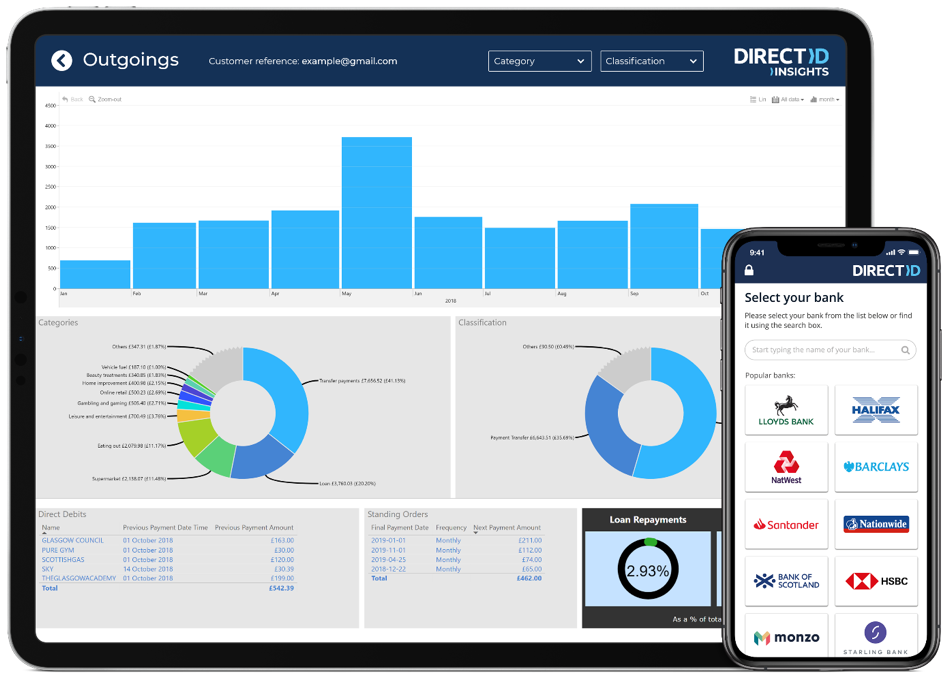
For customer’s Open Banking is as easy as logging into their Online Banking. For lenders it offers all the bank data that they could need to make to grant or deny a loan. As an added boon, without the customer sending in bank statements, the ability to make fraudulent applications, or make applications based on spurious details, is seriously curtailed.
With zero integration, DirectID Insights offers a host of options that are critical for Underwriters and Credit Risk Officers, including Account summary to see an overview of each account; Deposits and outgoings analytics; End of day balances; Loan servicing; Gambling analytics and; Transaction Reporting. DirectID Insights offers up to twelve months of bank data for each individual or business which is categorisedand classified.
We’re confident that DirectID Insights will prove to be a major success for The ID Co. As I said at the top of the article, the min criticism with Open Banking has been the lack of uptake. We firmly believe that this new product is a business-critical tool that will prove to be essential for anyone working in Credit Risk or Underwriting, and we have Open Banking to thank for its creation.
LendingCrowd in top 30 fast-growing tech startups – Interview with CEO Stuart Lunn
Stuart, well done on being named among the top 30 fast-growing tech startups to watch by Tech Nation. What do you think is the main thing that led to this recognition?
“Thank you! I think the Upscale team have recognised the progress we’ve made since we launched in late 2014, and potential we have to really take this business to the next level. It’s also great to see that 20% of the Upscale 4.0 cohort are fintech businesses.”
What does joining the 2019 cohort of Tech Nation’s Upscale 4.0 programme mean for LendingCrowd?
“This is further validation of our work in building a sustainable business capable of being scaled in a high-growth sector. We founded LendingCrowd to help bridge the funding gap facing so many small businesses, and the experience gained through Upscale and working with Tech Nation will be invaluable. We are proud to be based in Scotland, so it was pleasing to be selected as the only Scottish company to join this year’s Upscale programme. We hope this paves the way for more great Scottish businesses to be recognised.”
How is your firm transforming from being a start-up to being a scale-up business?
“Since our launch, we’ve always been focused on creating robust in-house infrastructure that can scale and underpin growth. This business is built on solid foundations of technology, financial services and regulatory experience, and we’ve proven the benefits of our business model in terms of enabling hundreds of SMEs to access the finance they need to grow. As we continue to bring in larger funds, we’re able to deliver higher levels of funding ”“ helping our borrowers create more jobs and generating real knock-on benefits for the economy.”
You on-boarded some very high profile collaborators last year on your board and in your marketing team. Are you planning on growing significantly more in 2019?
“We announced the appointment of Sir Sandy Crombie as our Chairman in November, and the following month Darren Cairns joined us as CMO. We hope to announce some more additions to the senior management team as we scale this year. In January alone, we’re advertising for seven roles on our careers page. Our team currently numbers 25 and I expect that figure will be close to 40 by the end of this year.”
What are your plans and objectives for 2019?
“To keep growing our investor and borrower base. We’ve now helped more than 570 businesses access over £50 million in funding, including more than £12 million in Scotland. As we attract more investors looking to make their money work harder, we’ll continue making a positive impact for our vital community of SMEs. We want to be the go-to company for Scottish SMEs that are being failed by traditional lenders.”
What’s your view on the future of P2P lending?
“We’ll see increasing levels of institutional money flowing in as the sector matures. Individual investors remain an important part of the mix, and I believe that financial advisers will increasingly recommend this market to their clients as an alternative to traditional savings and investments.”
2018 in Review & Orca’s Big Plans for 2019
2018 has been a big year for Orca. We launched the Orca Investment Platform, secured another funding round, and expanded the business in personnel and location. Not to mention, plans have been put in place for the launch of the Orca ISA and the Self-Select’ portfolio builder, a complementary product to the existing Model’ portfolio.
Here is our 2018 timeline of significant milestones”¦
February 2018 – Orca Investment Platform Launches
In February, we launched the Orca Investment Platform, an aggregator which integrates with multiple major peer to peer lenders, enabling investors to spread their capital and risk across platforms, sectors, and borrowers.
This was a massive moment for Orca. Years had been spent building up to this point and a tremendous amount of effort had been invested by many, many people. Special thanks to those who supported us, you know who you are.
September 2018 ”“ Seedrs Equity Crowdfunding Campaign Launches
We ran our first ever equity crowdfunding campaign. Using the Seedrs platform and admittedly unsure of how successful the campaign would be, we were delighted to exceed our £500,000 target in under two days!
With more than 400 investors, spanning dozens of countries, the response from the crowd ”“ including Orca users ”“ has been an especially rewarding feature of the year.
December 2018 ”“ Orca Secures Over £500,000 in Equity Funding
Following the close of the Seedrs campaign, and with contribution from venture capital funds, angel networks and private investors, Orca secured £574,280.
The funds will contribute to Orca’s development and growth plans for 2019.
Now, 2019, here’s the big pitch”¦
Q1 2019 ”“ Orca ISA
The Orca ISA will be a first of its kind in the market where investors can build their own portfolio and hold it in an ISA. Current ISA rules stipulate that people can divide their tax-year ISA allowance of £20,000 between ISA (e.g, Cash, Stocks & Shares and Innovative Finance ISA) accounts however they wish. But, they may only subscribe current tax-year subscriptions to a single IF ISA each year. This means it is very difficult to build a diversified P2P portfolio which is wrapped in an ISA. Investors typically hold one P2P investment within an IF ISA, while the remaining P2P investments are held in taxable general investment accounts.
With the Orca ISA, investors can hold multiple P2P providers in a single IF ISA. Here are the key benefits:
- Invest in the Orca Model portfolio suitable for hands-off investors or Orca’s Self-Select portfolio for the more active investor
- Earn interest up to 6.5%
- Earn returns tax-free
- Diversify ISA money across multiple P2P providers
- Transfer old ISA money
- Invest ISA money at non-ISA P2P providers
The company is already building a Wait List of investors eagerly awaiting the launch of the ISA.
Q1 2019 ”“ Self-Select Portfolio Builder
In addition to the launch of the Orca ISA, we are also launching a new product to complement the existing Model portfolio product.
The Self-Select portfolio builder allows investors to implement their own strategies, selecting only the P2P providers and products they wish to hold in their portfolio. What’s more, investors can build their portfolio and hold it in the Orca ISA.
2019 ”“ Integrate New Lenders
Throughout 2019 we’ll be seeking to introduce new lenders to the aggregator, offering investors greater choice and diversification. Updates on this will come in the new year.
2019 ”“ On-board EU Investors
We are investigating how we can on-board EU investors, something which we believe will stimulate growth in the UK P2P market and offer EU investors a simple access-point to UK P2P lending.
To find out more about our exciting new product developments, click here
Finally, a special thanks to everyone who has invested with Orca, your support is very much appreciated; the value early adopters offer businesses is immeasurable and helps shape future product iterations, so thank you from the entire Orca Team. Have a fantastic 2019!
An Origo and Fintech milestone
By Anthony Rafferty, Managing Director of Edinburgh-based Fintech Origo
This month marks a proud moment for Origo and a distinct milestone in Fintech history, namely the 10thanniversary of the launch of the Options Transfers service.
Origo was established in 1989 as a not-for-profit organisation with the remit to help the industry improve its efficiencies, cut its costs and improve the service to consumers. The Options Transfers service was launched in December 2008 to help improve the transfer times for pensions for consumers and the industry.
And the market certainly needed improving. At that time transfers of pensions, largely between pension providers and from pensions into annuities, was taking on average 50 working days.
From launch Options Transfers immediately started to cut down those times. The current and long-standing average transfer time is now just 11 calendardays, including the time required for banks to process monies through BACS.
In developing the Options Transfers service, Origo worked closely with the industry to revamp what was a largely manual process, and re-engineered it through the creation of new frameworks* and technology. These new legal and technological developments were instrumental in swiftly helping to reduce the time taken to transfer.
But the work didn’t stop there. We established user and steering group forums, working with the pensions companies within the large Options Transfers community, to monitor and review their transfer performance, which continues to help drive further performance improvements even today.
And, following its success with pensions, Options Transfers was quickly upgraded to support individual savings account (ISA) and general investment account (GIA) transfers, as well as occupational transfers. It is also the only complete transfers service in the industry, enabling secure and speedy transfers of pensions, GIAs and ISAs.
The service also helps pension schemes and third-party administrators to effect bulk transfers of pension members, where for example a scheme changes administrator or an employer changes scheme.
Furthermore, the users of Options Transfers are part of a trusted community ”“ over 120 financial services companies use the service ”“ focussed on improving their operations and delivering better service to the consumer. The Options Transfers user group and steering group feed into the service to ensure we are delivering what the industry needs including complete readiness ahead of any regulatory changes, the Pensions Freedoms being a significant case in point.
Above all, Origo’s Options Transfers service is focussed on improving outcomes for the industry and consumers and we are proud that since launch, we have transferred over £160bn for the industry, saved the industry over £600 million and importantly, saved consumers over 225 million transfer days.
10 years of Options Transfers service: Top 10 facts
- Options has transferred over £160bn in pensions, ISAs and GIAs for the industry
- 3.25 million pension transfers have been completed since launch
- 40,000 transfers have been processed each month since pensions freedoms
- The average transfer through Options takes 11 calendar days
- The fastest transfer processing completed by a ceding provider has been less than a minute
- 1.2 million transfers by ceding providers took place in less than 4 days
- Options has saved consumers 225 million transfer days
- Options has saved the industry over £600 million
- Close to 120 financial services companies use the service
- Origo Options is the longest running complete pension and ISA transfer service.
*Since 2017, the Origo Standards and Common Declarations have been operated by Criterion. The Common Declarations are free to use: https://www.criterion.org.uk/what-criterion-offers/
Glasgow Credit Union chooses Soar
Written by Laura Hillhouse, Marketing Manager at Soar.
It’s an exciting time for fintech disruptor, Soar, who have announced that they have been chosen by the UK’s largest credit union to be their new technical partner.
We have been selected by Glasgow Credit Union to provide its members with the latest banking technology as they aim to compete more effectively with traditional players in the financial services sector.
Soar, who provides credit unions with a range of innovative technology, will offer Glasgow Credit Union’s 50,000 members, a new market leading mobile app and internet banking platform.
Our new tech offers members one place to manage their finances and features such as join, borrow and manage your money allow credit unions to gain invaluable member insights and provides a better opportunity to offer them relevant products.
Executive Chairman of Soar, Andrew Duncan, said:

This new partnership is a huge step forward to help credit unions embrace the most up-to-date technology that can have a positive impact on their business.”At Soar, we believe it’s important for credit unions to invest in technology to remain relevant as we move into 2019 and be able to compete with others in the financial services market. As well as providing must-have mobile technology for members, we also offer those working in credit unions a dashboard that supports their operations more efficiently.Paul Mcfarlane, Chief Technology Officer at Glasgow Credit commented on our partnership, saying:“Working in conjunction with Soar and with the continued support of our existing technology partners, we’re improving on our great service offering to create a first-class experience for our members. We chose to partner with Soar because of their innovative approach and were impressed with the way they embraced our members’ requirements.”
It’s an exciting new relationship for both Soar and Glasgow Credit Union and we’re expecting to launch our new technology during 2019.
Scotland’s Minister for Trade, Investment and Innovation visits fintech Origo
Blog written by Anthony Rafferty Managing Director at Origo.
Origo was delighted this week to welcome Ivan McKee, Scotland’s Minister for Trade, Investment and Innovation to our Edinburgh headquarters.
He visited to talk about the work we do on behalf of the UK financial services industry, in particular to see a demonstration of our world-leading solution for the Pensions Dashboard and to hear about the important work being developed in Scotland to make the Pensions Dashboard a reality.
The purpose of the Pensions Dashboard is to find and display an individual’s pension savings on one screen and is intended to encourage people to engage with and, where appropriate, take action on their retirement income planning.
In his official comment on the visit, Mr McKee pointed out that Scotland is
“a highly competitive business location, with investment built around the quality of our research and innovation as well as the skills of our workforce.”
He added:
“Origo looks set to reinforce our reputation as a centre of excellence for financial services and FinTech by transforming the sector’s operating efficiencies. This includes the introduction of their Pensions Dashboard which will allow members of workplace pension schemes to see all of their pension savings at the same time in one private, secure place.”
At Origo, we are excited by the potential for Pensions Dashboard to not only benefit millions of consumers and potentially improve their financial outcomes, but also to help to drive further innovation in the pensions market by facilitating an open pensions environment.
We have been at the heart of the Dashboard project since its announcement in 2014, responsible for helping develop and prototype the core technology ”“ the Pension Finder Service ”“ and we were selected to provide a prototype to the HM Treasury sponsored Pensions Dashboard Prototype Project, which was the project managed by the Association of British Insurers (ABI).
More recently we provided input to the Department for Work & Pensions’ Feasibility Study and we have continued to develop the technological solution to an advanced state of readiness ”“ testing to an anticipated 15 million users, for example.
Our remit from our foundation in 1989 (making us one of the UK’s longest established FinTechs in Scotland and the UK) has been to improve the financial services industry’s operating efficiencies, lowering costs for market participants and improving outcomes for consumers.
In this respect we work collaboratively with government, other industry bodies as well as product providers, platforms, financial advisers, portals and software suppliers, to find new ways to cut costs and make processes more efficient.
Other industry-critical work we have carried out, for example, has enabled significant reduction in the amount of time it takes to transfer pensions (from c.50 working days to an average of 11 calendar days) and ISAs, as well as delivering and servicing digital IDs for 8 out 10 financial advisers in the UK.
The Minister met staff around the building and we talked also about Origo’s aspirations for the future of FinTech in Scotland and the UK, which we believe is very bright indeed.
NoMo Money: A PFM for today’s consumers
Article written by Author: Andrew Garden ”“ Product Manager @ The ID Co.
When I was approached two years ago by our company’s CEO, James Varga, and asked whether we could develop a consumer facing App, I was distinctly nervous about whether we could produce a product that could compete with some of the major applications that had already been launched and were launched soon after our conversation.
Two years on from that fateful afternoon, I couldn’t be happier with the release of our new customer facing App, NoMo (for No Money Mo Money!)
With hindsight, it was a great decision to focus on the customer side as well as the B2B offering, DirectID. Since its launch in 2015, DirectID has been a great success ”“ integrating with over 5,500 banks and building a customer base in Europe, north America and the UK.
Now it’s time for NoMo to take some of the weight.
Obviously, we’re a late entrant into the personal finance management (PFM) app space. In that time, there have been numerous releases, including many of the ones that we’re now very familiar with, from Yolt to Money Dashboard to Emma. I’ve taken a lot of time in looking at these apps, to understand their functionality, their key attributes and what we could do differently.
Essentially what I’ve found from having the time and space to develop NoMo, is that if you look at an App such as money Dashboard it has different functionalities ”“ from integrating multiple accounts, to categorisingspend and budgeting and planning.
That’s fantastic. I’ve used Money Dashboard myself and really enjoy it. But what we didn’t want to do was to recreate another version of what is already a very successful App.
So instead I took another approach, and asked “what is the biggest issue that people have with their money?” I think most of can agree, and unless we earn huge salaries, that the biggest issue is budgeting from one month to the next. From our research we know that this can create a feeling of helplessness around money, and this manifests itself by us burying our heads in the sand and hoping financial difficulties will go away.
In a saturated market, I wanted to find a way to make NoMo both stand out and be of value to users. We decided to go with a unique approach by giving NoMo a personality with references to popular culture. This way, regardless of whether users are up or down, they are spoken to like a friend. We wanted to make looking at your finances less like going to the dentist when you know that pain is on the way!
So, what we wanted from NoMo was to make it easy for people to know whether they were doing well in their finances. Ultimately this came down to one simple question “Do I have more or less money than at the same stage last month?” to which NoMo will show a simple graph ticker or message with a value that represents how much more or less money is in your account.
The summary provides a visual representation of the user’s budgeting performance over the month. The days of the month in orange represent the days the user has been down. Those in yellow represent the days the user has been up. The days in white are the days that the user has been on their average.


Commenting on the release of NoMo, The ID Co., CEO, James Varga said:
“We have been working on building a consumer App that allows customers to answer one very simple, but important question, and we’re confident that this premise means NoMo will be a great success with customers. It was important for us, that as well as being involved in working with financial institutions with DIrectID, we also have a consumer offering that will broaden our appeal within the market. Our research suggests that there is a very strong appetite for such an App and we look forward to receiving feedback now it has been launched.”
Indeed in these first few weeks there has been a huge amount of feedback, and to be honest, I’m delighted to receive this ”“ even the not-so-complimentary messages! To be honest, there hasn’t been anything that we either didn’t know about or were minor fixes. Moreover, we’ve learned a huge amount from the launch of DirectID. We’ve pulled in our experiences from the different industries that we work in, such as income verification, affordability, credit risk and lending, with the aim of bringing that knowledge to the benefit of consumers.
Moving forward, what we want to do is to be able to recogniserisky transactions that we can then flag to the user to try and be proactive towards their wellbeing. What this will mean is that when we release the Android verion ”“ hopefully by Christmas ”“ it should be perfect.
The feedback received along with the volume of downloads that we’ve had, even in these first few weeks, has given us a huge amount of confidence. I think we’ve touched upon a genuine need in the consumer market, which is for individuals to know quickly and simply whether they have more or less money than at the same time last month.
Shirley-Anne Somerville MSP welcomes Renovite Technologies’ plans for expansion
Shirley-Anne Somerville, the MSP for Dunfermline and West Fife MSP, met with senior members of staff and specialist developers at Renovite Technologies earlier this week to learn more about the businesses plans for expansion in the months ahead.
On October 1st, Ms Somerville was briefed by chief operating officer Jim Tomaney on Renovite’s plans for expansion and the payments software course the business is creating in collaboration with Fife College for the newly announced Fintech Skills Academy ’, which is scheduled to pilot in January 2019.
Earlier this year, an announced was made by the Scottish Government that Renovite Technologies received a £250,000 Regional Selective Assistance (RSA) grant from Scottish Enterprise for 28 new roles, three times the number currently employed by the payment specialist.
Jim Tomaney, chief operating officer, at Renovite Technologies said:
“We are grateful to Ms Somerville for her support and for taking the time to find out more about our plans for the business. It’s been a good year for us and we are looking forward to taking on a healthy number of new staff in the months ahead.
“In September, we launched Scotland’s first Fintech Skills Academy’ with Fife Council and Fintech Scotland which will be kicking-off in Fife College early next year. Today, we were able to give Ms Somerville a preview of what we are hoping to teach students and potential employees that sign-up to our specialist payments course, enabling them to hit the ground running.”
Dunfermline and West Fife MSP, Shirley-Anne Somerville added:
“As a growing hub of technology and innovation, it’s welcome news that companies are continuing to find new ways tap into Dunfermline and West Fife’s huge economic potential.
“Renovite’s growth plans, backed by their recently awarded Scottish Enterprise grant, will represent a substantial investment in the local economy, with the creation of new, highly skilled jobs.
“I’m delighted to see the company working with Fife College to help create new skills bases in our local area. Investing in young people will pay dividends in years to come, developing a workforce ready to take the lead in the fields of science and technology.”
Interview with Loral Quinn on being chosen for the Tech Nation programme
Well done Loral! What drove you to enter Tech Nation 2018?
We heard Eileen Burbidge’s keynote when we were pitching at EIE this year – as a Monzo investor, and with Sustainably’s beta being available for Monzo Bank customers, there were clear synergies with what we were doing at Sustainably, so we really wanted to meet her. We were very excited to pitch our idea to Tech Nation, with access to incredible judges including Eileen, who we want to help us on our journey.
It’s been a great year for Sustainably it terms of industry recognition. How do you explain it?
It’s been a positive year for us as a business, winning a number of industry awards, and meeting Richard Branson, who even wrote a blog about us! There is a real shift towards more social responsibility and sustainability in business, and a rise in ethical consumerism, and that fits in perfectly with our mission. We’re also seeing a lot of charities hire innovation managers, who are coming to us to help them to engage and attract new audiences through our technology.
It’s not the first time you’ll be travelling to the US, how important is it for fintechs to develop an international network?
Our growth strategy for Sustainably is very much international. The US is a key market for us and we’re looking to build our partnerships there for international growth.
What does entering this programme mean for Sustainably?
The Tech Nation fintech programme will enable us to connect with other fintechs for peer learning, and access entrepreneurs in the fintech eco-system who can help coach and mentor us through our next growth phase. For us it’s all about learning, to enable us to create products people love and make more positive impact in communities.
What does the end of the year look like for you?
We need to be laser focused on product, so that’s our key priority, as is onboarding additional members of the team and our pipeline of good causes. We hope to make some major announcements soon in terms of partnerships, and we’ve got some great people lined up to join the team.
What challenges do you hope to overcome thanks to Tech Nation?
We hope that by being part of Tech Nation it will help raise our profile, help us with our ambitions for international expansion, and connect us to a peer group to help us learn, partner, grow.
Castlight – CaaS tool extended across the affordability spectrum
Blog written by Phil Grady, Chief Executive, Castlight
Over the last couple of years Castlight Financial has invested in the development of our CaaS (Categorisation as a Service) tool, to provide a range of affordability solutions.
The CaaS engine, powered by our own API, uses open banking technology to allow a customer to share his or her transactional information in real time. CaaS then categorises the transactions across any number of accounts into 155 categories of expenditure and 29 categories of income. Categories include credit commitments, essential costs and discretionary spending and then drills right down to all sorts of discretionary spending such as Costa coffees on the way to work, lottery tickets and haircuts.
Up until recently, the CaaS technology has primarily driven our popular Affordability Passport, used by lenders to get a full picture of a customer’s finances at the press of a button. Given that the Affordability Passport process also eliminates the need for lenders to trawl through bank statements and pay slips to review discretionary and non-discretionary spending, lenders are able to offer customers a transformative 10-minute mortgage process. When the market typically assumes an average consultation of around 3 hours with a mortgage broker to secure a loan, the Affordability Passport is truly shaking up the lending industry.
Leading UK banks and brokers have been quick to embrace the Affordability Passport and are currently rolling it out to their customer bases.
But we’re a team of disrupters and we like to keep making ripples in markets, so this summer we took the decision to extend the implementation of CaaS right across the affordability spectrum.
Let’s assume that most people using our Affordability Passport are looking for a mortgage or a loan to enhance their lifestyle. They use credit, but they don’t have problems with debt. They are somewhere in the middle of the affordability spectrum.
But what about the people who, at one extreme of the affordability spectrum are struggling with debt and at the other have income surplus to their current lifestyle requirements, which should be effectively invested and managed?
This summer we prioritised the development of The Big View, a fintech tool powered by CaaS, which empowers people with debt issues, by providing them with access to their own data. The pilot scheme was launched with the Big Issue Invest and Advice Direct Scotland (ADS) in June. Since then any client who requests a Big View analysis has had the opportunity to get an in-depth, 360-degree view of their finances and to work with ADS advisers to interpret the findings and develop highly individualised solutions.
And in the last few weeks, we have had a team working on CaaS for Wealth, a tool designed to help Asset Managers provide the best possible service for their customers. Using the functionality of the CaaS transactional categorisation powerhouse to conduct a wealth assessment, CaaS for Wealth will not only report on exactly what and when a customer spends but will also use its trained engine to identify risk, patterns, behaviours and appetites.
We’re talking to forward thinking asset management companies just now and working hard to bring this product to market. Another revolution is on the way.
We believe that no-one is average, so an affordability product can never be one size fits all. People are somewhere on an affordability spectrum so that’s where our financial affordability solutions haveto be too.