
Consumer Duty and fintech innovation
Season 3, episode 4
Listen to the full episode here.
In July 2022, the FCA published its Consumer Duty. Regulated firms need to implement the new rules by the end of July 2023 for open products and July 2024 for closed books of business.
Firms will need to review their products, communications and customer journey.
It will impact most areas in those organisations such as governance, reporting, product design, pricing, distribution, servicing and staff training.
In this podcast we will review the key principles, ask ourselves what the impact on both established firms and fintechs is as well as exploring innovative technologies that can help adhere to those new rules.
Guests:
Venetia Jackson – Senior Associate at Pinsent Masons
Joseph Twigg – Founder and CEO at Aveni
Chris Ansara – Founder and CEO at docStribute
The Ardonagh Group selects fintech AutoRek
Scottish fintech AutoRek, just announced that The Ardonagh Group was the latest addition to their client list.
The UK’s largest independent insurance distribution platform selected AutoRek as they want to drive efficiency in key back and middle office Insurance Broker Accounting (IBA) processes using intelligent automation technology.
AutoRek will support two key areas of the IBA operations within the group:
- Automation of the statement reconciliation process (Over 2500 statements monthly, made up of over 400 different formats) against two key Policy Administration Systems (PAS), Acturis and OpenGI. AutoRek will then feed the output of reconciliations through the Ardonagh PAS systems so results can be posted back into systems and updated in records.
- Reconciliations in the Cash Posting and Allocation (CPA) team, including matching cash payments from banks, card transactions and premium credit against records held in the Ardonagh Acturis and OpenGI PAS systems. The output of these reconciliations will then be loaded back into the PAS systems and allocated out on a policy level, updating the systems.
Gordon McHarg, CEO at AutoRek, added,
“It is a huge success for AutoRek to have the calibre of a client such as The Ardonagh Group come on board. We see potential to work together over the coming years on many different projects.”
Piers Williams, Insurance Lead at AutoRek, added,
“We are delighted to be working with The Ardonagh Group and helping the business achieve its objectives in the coming years. AutoRek continues to grow its insurance presence quickly, and it is great to see that our No Code intelligent automation solution continues to improve back and middle office financial operations processes while increasing operational efficiency.”
Paula Jones, Head of IREC at Ardonagh Advisory, added,
“The IREC solution and build with AutoRek will revolutionise the end-to-end process within The Ardonagh Group. Enabling our fast-growing business through organic growth and the targeted acquisition plans to integrate the key finance operations smoothly and efficiently”.
Bari Irving-Philips, Head of IBA and Client Money at Ardonagh Advisory, added,
“It is an exciting time for The Ardonagh Group to be working with AutoRek. The AutoRek platform and No Code technology will enable the Client Money function to work smarter and more intelligently; further enhancing the contribution that the function brings to the Group and our Clients & Insurers.”
AutoRek to hire a further 30 positions
Scottish fintech Autorek, is growing its team to cope with an unprecedented level of demand for it financial control and regulatory reporting solutions. The company has already recruited 40 people in 2022 and is looking at filling 30 more positions across the U.K.
This rise in demand can be attributed to a need for more integrity and accountability across the financial services sector, leading to increased regulation, especially across the payments and asset management industries. The FCA’s new Consumer Duty, which was introduced on 27th July, is the most recent example of this market shift.
AutoRek’s CEO, Gordon McHarg comments:
“We currently have 140 employees, and we’re projecting this number to rise to 170 by the end of the year to keep up with the demand from clients and prospects. We’re extremely proud that the average tenure of employees is currently four years – more than double the sector norm for most fintechs, with almost 40% of these employees playing a huge part in the growth journey with four years or more as part of the AutoRek team.”
He continued,
“The demand for greater automation is at the centre of our need to continue hiring. Within the payments, asset management and insurance sectors, the increasingly complex regulatory landscape is forcing firms to automate to keep pace with their competitors and their own customers’ expectations. Therefore, we have a particular focus on hiring SMEs in each of our sectors, with a number of positions available in insurance. As we look to expand our services internationally and focus on growing software engineering, professional services and sales, we expect this growth to continue as the global business world embraces the benefits of automation.”
RegTech, why now is the time to start caring
Season 1, episode 5
Listen to the full episode here.
Financial Regulation Innovation (RegTech) was highlighted in the FinTech Scotland Research and Innovation roadmap published in March 2022 as an essential area of focus for the financial sector.
Understanding and managing regulatory requirements costs financial institutions millions of pounds every year. As regulation evolves all the time to protect consumers, so do new tools and technologies. In recent years new solutions have emerged to help companies reduce cost, better understand requirements, and meet their reporting obligations. Open Banking, AI, Machine Learning and many more technologies have led to increased innovation.
In this podcast we will discuss what RegTech means, adoption within the financial sector and why now is the time for financial firms to consider and explore innovation around financial regulation. This podcast will also be an opportunity to promote the upcoming fintech table event during Scotland FinTech festival.
Guests:
Yvonne Dunn – Partner at Pinsent masons
Callum Murray – Founder and CEO at Amiqus
AutoRek wins ”˜Best CASS Solution’ Award
Scottish fintech company, AutoRek, just announced it won both the Best CASS Solution’ and Best Wealth Management Solution of the year at the City Financial Technology Awards 2022.
Lyn Canavan, Head of Marketing at AutoRek, commented,
“We are delighted to have won this prestigious award and to be recognised again as a provider of the Best CASS Solution’ by the Systems in the City Financial Technology Awards judging panel. We have developed our CASS solution with our clients over the years to fine tune it into the best CASS solution. The recognition is a reflection of the hard work and dedication of the AutoRek team behind the scenes.”
The Awards are organised by Goodacre and recognises service and system suppliers for their innovation. Based on an independent and factual annual accreditation process, the selection process is overseen by three independent judges.
The Awards provide an important point of reference for user firms assessing the suitability of their operational infrastructure.
Autorek appoints new CTO
AutoRek has just announced the appointment of its new CTO, Andrew Elmore, former PagoFX and C24 Technologies.
Andrew has extensive financial services knowledge gained from previous roles including Head of Technical Architecture at PagoNxt, VP Engineering at Velo Payments and heading up development at SmartStream.
Elmore will look after all technology activities, from product definition and implementation, through to the 24×365 operation of the cloud reconciliation service.
He will also help the fintech to scale, ensuring high quality and reliability standards of services while increasing the delivery pace and capacity.
Gordon McHarg, AutoRek’s CEO, commented:
“AutoRek’s rapid growth over the past few years has been very exciting and with continued plans for recruitment and expansion, we are delighted to have Andrew Elmore join us with his past experience to help drive the company in the direction we have set out.”
Andrew Elmore, CTO at AutoRek commented:
“I am very excited to join AutoRek as part of the next stage of their exciting growth. AutoRek’s broad product functionality, market-leading matching engine, domain expertise and cloud platform are dramatically reducing the time and cost for clients to improve their Straight Through Processing (STP) and operational efficiency. Combined with a relentless focus on customer success, I believe AutoRek will continue to be the best choice for traditional and next-gen financial institutions alike.”
Financial Regulation ”“ the opportunity for FinTech Research & Innovation
The UK’s approach to financial regulation has been key in enabling a dynamic financial services sector that supports and drives the economy, enables a progressive economic outlook, creates jobs, and plays a significant role as a global financial service centre.
The development of this Roadmap highlighted financial regulation as a priority theme because of its fundamental role in FinTech and financial services, as well as the need for financial regulation to support the positive role FinTech innovation could play in the future of finance.
Regulation remains extremely complex for all those operating in the finance industry. Depending on the complexity of the financial institution’s business model, meeting compliance obligations can mean significant costs.
Industry research suggests that some of the largest global financial institutions are spending up to 5% of revenue on regulatory compliance. Across the UK this could mean the annual cost of demonstrating regulatory compliance is as much as £6.6 billion.
Throughout the development of the Roadmap, contributors highlighted their interest in the role technologies could play in future financial regulation. Some examples are AI, advanced analytics, high performance computing including quantum computing, and distributed ledger technologies.
Priority areas in Financial Regulation
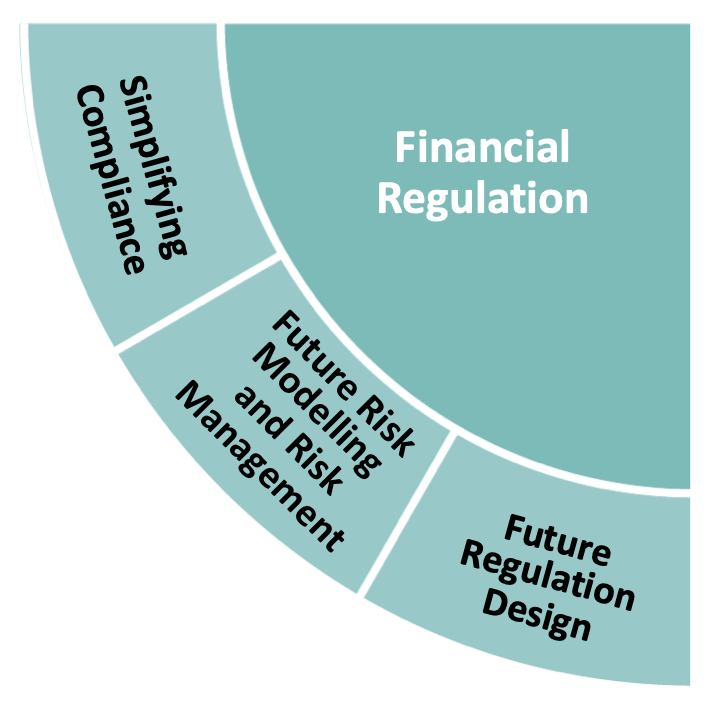
The industry contributors to this roadmap offered a view that the future looks set for significantly more change. Our analysis highlighted three topics of interest:
Simplifying compliance
Helping financial institutions create new solutions and use FinTech to help meet current, continuously changing, and global regulatory obligations.
Future risk modelling and risk management
Reinventing risk management with technology and data analytics, and enabling new approaches to fight financial crime, address fraud and focus on emerging climate risks.
- Reinventing risk management with technology and data analytics
- Enabling new approaches to address fraud and fight financial crime
- Modelling for new and emerging climate risks
Future regulation design
Enabling an agile regulatory framework that works for all, and developing future regulatory oversight or supervisory technology.
- Regulatory reporting
- Interoperability and data standardisation
Roadmap next steps: Financial Regulation
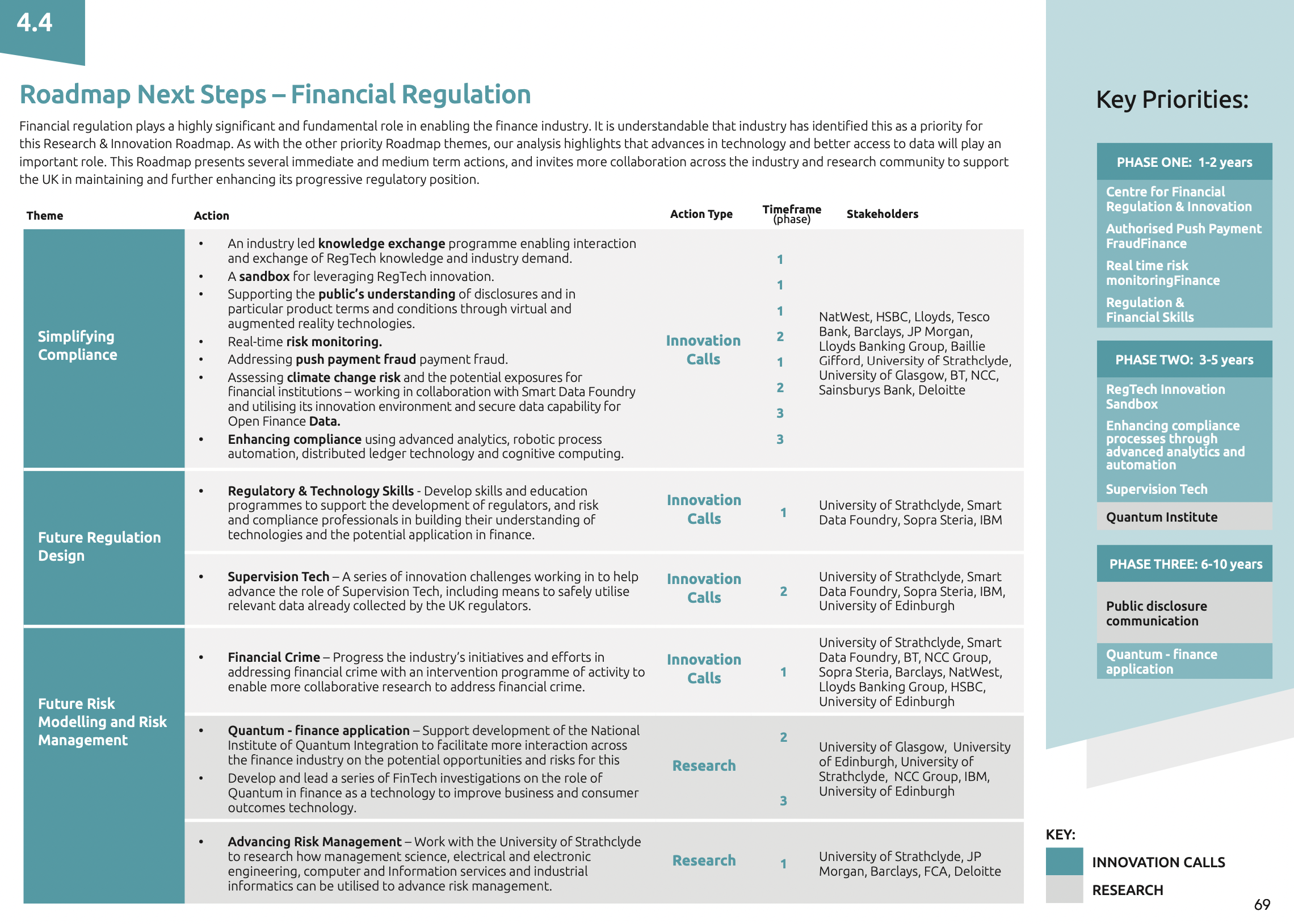
A range of proposed next steps are laid out in the published Roadmap, which specifically identifies 13 actions relating to Financial Regulation, and categorises each into one of three phases over the next 10 years. These actions are illustrated in the graphic below. The report also references 23 different stakeholders who can support the implementation of these actions, which are broken down into research projects and innovation calls.
More information about FinTech Scotland’s Research & Innovation Roadmap can be found here, where the full Roadmap can also be downloaded.
The FinTech Research and Innovation Roadmap
Season 2, episode 1
Listen to the full episode here.
In March 2022, FinTech Scotland released its 10-year Fintech Research & Innovation Roadmap for the UK.
In collaboration with leading universities, large financial institutions, fintech businesses, citizens, industry experts and senior officials this report explores the opportunities that will help the UK maintain its fintech leadership globally.
In this episode we explore what this roadmap means for Scotland and what the next steps are to deliver on the roadmap recommendations.
Increasing industry use of encrypted email to combat cybercrime
Recognition amongst financial services businesses of the need to safeguard emails is increasing in the face of financial cybercrime and they are taking action. Origo’s Unipass Mailock recently marked its one millionth email sent though the encrypted system.
Industry providers such as Aegon and Royal London are using military-grade encryption email services to protect their email exchanges with financial advice firms, and other providers are also realising email protection is now essential.
Cyber criminals hack vulnerable email systems and employ sniffer programs which identify valuable emails and take copies of them, which the criminals can then exploit. For example, in just one email in which a client sends their personal and asset details to their financial adviser, there would be enough detail to help criminals commit fraud.
Putting in place a secure, military-grade encrypted email system, one which protects emails in transit, and ensures that only the intended recipient can access the email, as well as providing an audit trail for compliance purposes, now needs to be thought of as base-level security for product providers and financial advice firms, and without a doubt where confidential and transactional data is being sent.
It is also another way for providers and firms to demonstrate value to their respective customers in the precautions they are taking to safeguard their data.
Origo’s Unipass Mailock system has now surpassed one million emails through the system. Looking at industry benefits, not only has this protected over a million communications between providers, advisers and their clients, but we calculate that this equates to £1.9m saved in print, packaging and postage costs, as well as climate related savings of 459 tonnes of CO2 and 154,000 tonnes of water.
The risk to businesses is not just potentially having to compensate clients for losses, and meeting fines imposed by the Information Commissioner’s Office (ICO), but the effect on client trust and the reputation of the business.
As we move to a more digital advice experience, we expect to see companies of all sizes look to protect this potential point of vulnerability and employ encrypted email as a matter of course.
Standard security protocols advice firms can follow
Some general basic actions businesses can take to help protect their businesses against cybercrime, include:
- Having in place standard items of internet hygiene including firewalls, anti-virus software and a virtual private network (VPN) for off-site working.
- Identifying where the risks to the business lie ”“ are they with providers or are they in unsecured communications with the end client?
- Implementing formal processes and procedures, and staff training, to raise awareness of the potential dangers, and how to protect the business against them.
- Having formal cybercrime processes written into a firm’s policy documents, including written instructions for staff to follow where, for example, fraud is detected.
- Having in place appropriate controls for inward and outward communications ”“ such as encrypted email.
- Letting your customers know the potential dangers and what you are doing to protect them.
Photo by Markus Spiske from Pexels
Drivers for Growth? People, Technology and Regulations- a collaborative approach
Driven by digitalisation, fintech is one of the most important innovations embedded in everyday transactions, supported by emerging technologies including automation, cloud computing, artificial intelligence, blockchain, smart contracts, and machine learning.
While fintechs are here to stay, the image of the future is a little uncertain. Challenges such as the modernisation of financial architecture and changing consumer perceptions, the disruption of existing service models, incumbent employers and regulatory frameworks posing double edge implications for the overall ecosystem, and to access human capital, a discussion initiated by the University of Dundee Business School inviting FinTechs, regulators and Academics.
Regulators’ concerns have become increasingly complex because of technological integration and at times, fintechs exist in an environment with limited guidance. This challenge is underscored by regulatory regimes that multiply across countries, states, and even regions, a point emphasised by Professor Hisham, Birmingham University Business School, added how the terms around fintechs are not”¯comprehensive or standardised, which needs to be addressed in order to enable the”¯ecosystem to”¯grow.
Quicker responses from financial markets are crucial in terms of developing new instruments to battle the challenges about security and reliability of data and in terms of developing the regulatory framework, fostering relational and behavioral trust with consumers.
We must understand that regulations can be a barrier too, another point emphasised by industry experts, emphasising the need for a more balanced approach that allows flexibility and innovations. Najia ( Securities Exchange Commission of Pakistan) shared a regulatory perspective by adding that attitudes are shifting as a result of regulatory sandbox initiatives, providing a safe environment for early-stage development for fintech start-ups to test their innovations without the need for full license, thereby, playing another critical role in the development of fintech, ultimately breaking down the current regionalism of the sectors.
Nonetheless, different countries are at different stages of fintechs growth, for developing countries like Pakistan, a bigger issue is contract enforceability, suggesting that the biggest challenges are from the other side of the table, hence being mindful of the fact of how”¯the investors are and can be protected. This signifies the emergence of new developments and technological innovations that can help to develop a global friendly fintech ecosystem, breaking down the current regionalism of the sector.
“”¦.Fintech innovations will only become more pervasive in everyday transactions as their adoption increases and more inclusive and open regulatory frameworks allow them to grow.” [Stephen Ingledew, CEO at FinTech Scotland]
Opportunities abound for fintechs to engage in dialogue with regulators and raise awareness of rapidly emerging technologies and consequences they may have for market integrity, stability, and sustainability. Knowledge shared between regulators and fintech companies can enhance regulators’ awareness of consumer habits, behaviours and desires.
The technology supports the human understanding, where the growth opportunities are, but it will never replace a human in making those decisions, a point emphasised by Clive representing ACCA and Morris, Dean of Dundee Business School, adding that Digital transformation requires a transformation of people, technology, and processes, with people being the most important factor.
The key challenge organisations are facing globally, is the right talent. Despite searching for it, businesses are not getting the right people to assist them in this particular transformation. You can’t really have one without the other, Marijus (NCR) and James (Zudu), Tayseer (SadaPay) and Hazel (Candocollective) continuing the debate, suggested that people are extremely important, especially development of human capital, we need to put more emphasis on people’s learning, not only in their own skill set and knowledge, and also for their cross-functional flexibility.
After all, everything connects and technology, human capital, and businesses are dependent on each other now maybe more than ever before. The importance of educators was emphasised by most participants in reducing the gap between the needs of FinTechs and the offer of the current human capital market.
Overall, the promises offered by fintech certainly far outweigh the risks, at least in the medium to long term! However, we need to act now and get the regulatory environment and the human capital market “fintech ready”.
Participant organisations:
University of Dundee Business School ; SadaPay; Sehatkahani; Fintechscotland; Securities Exchange Commission of Pakistan; Candocollective; Birmingham University Business School; Zudu; NCR; ACCA; Tez Financial Services