
Morgan Stanley appoints Angela McCann as Head of Glasgow office
Morgan Stanley today confirmed the appointment of Angela McCann as Head of Glasgow
In her new role, Angela will be responsible for overseeing Morgan Stanley’s Glasgow office, which supports a wide range of business functions and plays a key role in Morgan Stanley’s global operations. Having joined Morgan Stanley in 2006, she brings over two decades of experience across a broad range of Finance leadership positions.
In addition, Angela will continue to serve as Head of Glasgow Finance, a role she has held since 2022. She is also a senior champion of Morgan Stanley’s socio-economic inclusion strategy and serves on the Firm’s EMEA Inclusive & Sustainable Ventures Committee.
Angela McCann, Managing Director and Head of the Glasgow office, said“Glasgow has been an important part of my career, and having grown up in Scotland, it is a real privilege to take on this expanded role. The office plays an important role in supporting Morgan Stanley globally, and I look forward to building on the strong foundations already in place while continuing to invest in our people and the local community.”
Angela’s 20-year career with Morgan Stanley includes nine years in New York, where she held senior Finance roles and led key strategic initiatives within Corporate Tax.
Prior to joining Morgan Stanley, Angela worked for six years in financial management roles within the telecommunications sector across several international locations including the Philippines, Taiwan, Atlanta and Seattle. She is also a Chartered Certified Accountant (ACCA).
BehaviourAI Lab
The AI Sovereignty Trap: Why UK Financial Services Are Sleepwalking Into It
By Nagu Gopalakrishnan, Co-founder, Vidai
Governance cannot live at the application layer for regulated platforms. I learnt that running regulatory engineering for the Ads Creative Infrastructure programmes at Amazon, taking us through EU Digital Markets Act and Digital Services Act compliance, MiFID II‑grade regulation for large platforms, with penalties of up to 10% of global turnover. You either build a horizontal control plane that every product team inherits, or you spend the next five years putting out fires one integration at a time.
I am watching UK financial services make the second choice with AI right now. The regulators have already told them not to. And the economics of agentic AI will punish them for it before the regulators do.

The Problem Is Jurisdictional, Not Operational
Most conversations about AI vendor strategy in financial services frame the issue as cost or flexibility. Pick the right model. Negotiate the right rate. Avoid getting trapped on a single roadmap. These are real concerns, but they miss the deeper one.
Extraterritorial data laws are a fact of the cloud era. The US CLOUD Act is the most discussed example: it allows US authorities to compel any US‑headquartered provider to disclose customer data they hold anywhere in the world. Other jurisdictions have similar mechanisms. The relevant question for a UK‑regulated firm is not ‘which country?’ but ‘how many jurisdictions does my AI stack expose me to, and have I done it consciously?’.
Data residency clauses help less than they appear to. A contract with your UK‑region cloud provider has no force over the frontier model providers your applications then call into; those are separate contractual relationships, often with different jurisdictional anchors. The EU‑US Data Privacy Framework offers some cover for one specific corridor, but it has been struck down twice already and faces a credible third challenge.
For a UK firm serving Scottish or EU customers, every model API call sends data outside the protections that residency contracts negotiated — and across an agentic workflow, those calls compound into exposure most firms cannot quantify.
This is precisely the concentration risk the UK’s Critical Third Parties Regime (CTPR) was designed to confront. CTPR is, at its heart, about systemic dependencies on a small number of providers serving the financial system. A single AI provider handling AML triage, customer correspondence drafting, claims assessment or internal policy retrieval is the textbook example.
Agentic AI Makes It Worse and More Expensive
The shift to agentic AI changes this calculus by an order of magnitude. When a human asks a model a question, the data exposure is one prompt. When an agent runs a fifty‑step reasoning loop touching customer records, transaction history and internal policy documents, every step is a potential exposure path, and every step is a billable token.
Forrester predicts machine‑initiated traffic to financial institutions will surge by 40% by the end of 2026, while human visits drop by 20%. That is not a usage statistic. It is simultaneously a sovereignty exposure curve and a cost curve. Most current AI governance tooling was built for neither. Whether you are a tier‑1 bank, an insurer, an asset manager or a fintech selling into regulated buyers, the maths is the same.
The cost side of that curve is worth dwelling on. A workflow that costs pennies in pilot can cost five‑figure sums per day in production once the agents start chaining. Most finance teams in regulated firms were not staffed to forecast that, and most current AI tooling does not give them the visibility to try.
The dominant approach today is to bolt observability and policy enforcement into application‑side libraries written in Python or Node, designed for episodic human chat traffic. Under sustained machine‑to‑machine throughput, these layers do not fail loudly; they fail expensively. We benchmarked our Rust‑based control plane against a leading Python gateway on identical workloads, and we held up nearly double the throughput‑per‑core on hardware four generations older. The full methodology and source code are public at vidai.uk/blog/rust-python-vidai. The headline number matters less than what it implies: the architecture you choose for your governance layer determines whether multi‑model AI is economically viable at agentic scale, or whether it cannibalises your margins the moment traffic ramps.
The Control Plane Answer
A horizontal control plane, sitting between your applications and the models, should deliver governance across three axes — sovereignty, cost and compliance — and one engineering concession that makes adoption possible.
Sovereignty by design: Vidai runs entirely inside your VPC, deployed in minutes. No SaaS path, no phone‑home, no licence ping, no usage telemetry. We do not see your prompts, your responses or your timing. Your data, your control, your infrastructure. Egress is enforced inside the control plane: you decide what crosses to model providers and what does not, including from your own applications. That removes a class of third‑party dependency a SaaS gateway would add, and that CTPR would expect you to register
Cost governance: Real‑time, per‑team, per‑agent, per‑request, per‑workflow, per‑model spend is the floor. The ceiling is full historical lineage of how pricing changed over time. When a provider shifts rates mid‑year, your finance team can see what the same workload would have cost under the old pricing, what it costs now and what it would cost if re‑routed. Cost‑based routing then closes the loop, sending each workload to whichever provider is cheapest for that latency profile at that moment, not whichever vendor has the lowest headline rate.
Compliance governance: A single security and compliance review covers every model behind the control plane, with full request and response retention for regulatory inspection. Adding a new provider becomes a configuration change, not a six‑month procurement cycle. The ‘sign‑off tax’ that pushes regulated firms towards single‑vendor lock‑in disappears.
A drop‑in path, not a re‑platforming project: Most gateways force engineering teams into an OpenAI‑compatible shape, which means every team using Anthropic, Bedrock or Google native SDKs has to refactor before they can join the control plane or add an additional application‑side library. Vidai sits transparently in front of whatever SDK is already in production. Joining the control plane is a base URL change, not a sprint. That single design choice is often the difference between a multi‑model strategy that ships this quarter and one that lives in a slide deck for two years.
This is what we are building at Vidai, from Scotland, with a team whose backgrounds span hyperscale EU regulatory navigation and national critical infrastructure resilience. The combination is deliberate. The next decade of financial AI will be defined less by which model wins and more by who governs the substrate the models run through.
The Choice for UK Financial Leaders
The UK has a window here that will not stay open for long. CTPR is live. DORA is live. The Bank of England, FCA and PRA are all signalling that AI concentration risk is moving up the supervisory agenda. The firms that build their multi‑model strategy now, on a sovereign control plane they actually own, will be ahead of the requirement when it lands. The firms that wait will be retrofitting under regulatory pressure, on someone else’s timeline.
The goal is not to pick the winning AI model. It is to build the infrastructure that lets you use any winning model without losing control of your data, your budget or your sovereignty.
That is a decision that gets made at the architecture layer, not the application layer. And it gets made now, or it gets made for you.
Localising for North America: Lessons for Scottish Fintechs
By Atlantic Fintech
Expanding into North America is a natural next step for many ambitious Scottish fintechs. The market is large, sophisticated, and innovation-friendly – but it is not a single, unified landscape. Success depends less on scaling what already works at home, and more on adapting thoughtfully across product, language, and market expectations.
At Atlantic Fintech, we’ve worked closely with fintechs on both sides of the Atlantic. A consistent theme emerges: localisation is not a final step – it’s strategy from day one.
North America Is Not One Market
One of the most common misconceptions is treating North America as a single, homogeneous opportunity. In reality, it is a patchwork of regulatory environments, consumer behaviors, and financial systems.
- Canada and the U.S. operate under different regulatory frameworks, with further variation at the provincial and state levels.
- Payments infrastructure differs significantly (for example, Interac in Canada versus ACH and card-heavy systems in the U.S.).
- Procurement cycles, especially in financial institutions, tend to be longer and more relationship-driven than in the UK.
For Scottish fintechs, this means market entry should start with a clear geographic focus rather than a continent-wide approach.
Product Localisation: Beyond Compliance
Adapting your product for North America goes well beyond regulatory compliance. It requires aligning with local user expectations and financial habits.
- Integrate with region-specific payment rails and financial data systems.
- Reflect local financial terminology and user flows (e.g., “checking account” vs. “current account”).
- Ensure your product aligns with local security expectations and trust signals, which can vary by market.
An example: a fintech offering open banking-enabled services in the UK may need to rethink its data access strategy in North America, where open banking frameworks are still evolving and often rely on different providers and standards.
Language and Communication Nuances
Even in English-speaking markets, language localisation matters more than many expect. Subtle differences in tone, terminology, and messaging can affect credibility and conversion.
- North American audiences tend to prefer more direct, benefits-driven messaging.
- Marketing content often leans less on understatement and more on clarity and value proposition.
- Bilingual requirements – particularly in Canada – add another layer. French is not optional in Québec and can strengthen brand trust nationally.
For Scottish fintechs, this is less about translation and more about transcreation: ensuring your message resonates culturally, not just linguistically.
Finding Product-Market Fit
Product-market fit in North America often requires iteration, even for well-established companies.
- Customer expectations around onboarding, UX, and support can differ significantly.
- Enterprise buyers may expect local presence, partnerships, or pilots before committing.
- Pricing models may need adjustment to align with local purchasing norms and budgets.
Partnerships can be a powerful accelerator. Collaborating with local fintech ecosystems, financial institutions, or innovation hubs can provide faster access to networks and insights.
A Note on Atlantic Canada
While Toronto and New York often dominate conversations about North American fintech, Atlantic Canada offers a compelling – and often overlooked – entry point. Atlantic Canada can serve as an effective “soft landing” zone for international fintechs. It allows companies to test, adapt, and refine their North American strategy in a more agile and supportive setting before scaling into larger markets.
The region also shares many similarities with Scotland: a growing fintech sector made up of over 150 ambitious fintechs, strong ecosystem support from government and industry, and a collaborative, community-driven approach to innovation. Scottish companies looking for a familiar yet globally connected environment can benefit from:
- Close-knit fintech and startup ecosystems that enable faster relationship-building.
- Lower operational costs compared to major financial centres.
- Direct access to both North American and European markets through strong trade ties and cultural alignment.
Building for Scale Through Localisation
The most successful fintechs entering North America are those that treat localisation as a growth lever, not a constraint. They invest early in understanding regional differences, build adaptable products, and engage deeply with local ecosystems.
For Scottish fintechs, there is a strong foundation to build on: a reputation for innovation, strong regulatory understanding, and a global outlook. By pairing these strengths with a deliberate localisation strategy, North America becomes not just accessible – but highly scalable.
About Atlantic Fintech
Atlantic Fintech drives fintech innovation and growth across Atlantic Canada’s four provinces: New Brunswick, Nova Scotia, Prince Edward Island, and Newfoundland and Labrador. The organization builds a global fintech community by providing startups and scaling fintech companies with strategic connections, industry expertise, and market entry resources. Atlantic Fintech focuses on fostering collaboration and positioning Atlantic Canada as a recognized fintech hub of international relevance.
Atlantic Fintech offers tailored growth programs, specialized mentorship and go-to-market support. Having developed a strong ecosystem that integrates local talent with global fintech markets, leaders praise the community’s growth opportunities, strategic introductions, and educational events that empower companies to compete worldwide and build sustainable fintech ventures.
Winning in APAC: Five Common Mistakes WealthTech Firms Make – and What Actually Works
By Patrick Donaldson, Founder, Mkt Dev APAC with Steven Carroll, Founder, CCAS
After a recent visit to Glasgow and Edinburgh, and a good conversation with Aleks Tomczyk, Chief Executive at FinTech Scotland, it struck me how many fintechs based in Scotland are starting to look seriously at Asia-Pacific (APAC) regional expansion – often with limited on-the-ground experience. The mistakes I describe below come from what I have watched play out with firms entering APAC from major wealth and financial centres in Europe and North America over the past decade. The patterns are consistent, and the underlying discipline travels.
I have spent close to three decades on both sides of financial technology – eighteen years as a wealth management practitioner at firms like Barclays Wealth (originally at Greig Middleton stockbrokers in Edinburgh), then eleven years on the vendor side at Thomson Reuters, Refinitiv and LSEG, building commercial businesses across APAC. I now run Mkt Dev APAC from Singapore, helping firms from outside the region design and execute the right entry strategy for APAC markets.
My lens is WealthTech, and that is where my direct experience sits. Many of the patterns travel across other fintech verticals – payments, regtech, lending, data – but I will speak to what I know. This is written for founders and commercial leaders of Scottish WealthTech firms who are starting to take APAC seriously.
Here are the five most common mistakes I see, and the playbook that actually works.
The opportunity is real – but it isn’t free
APAC is the fastest-growing wealth management region in the world. Private capital is flowing into Singapore and Hong Kong at scale, family offices are multiplying, and the region’s private banks and wealth platforms are investing heavily in technology to serve an increasingly sophisticated client base. The numbers vary by report, but the direction of travel is unambiguous.
That opportunity has also drawn a lot of entrants. Many of them will fail. Not because the market rejects them – because they arrived with the wrong plan.
From Edinburgh or London, it is tempting to see “APAC” as one more region on the sales dashboard. On the ground, it behaves like multiple distinct markets that reward discipline and punish generic expansion.
Common mistake #1: Treating APAC as a single market
APAC isn’t a country and it doesn’t behave as a single go-to-market region. Singapore, Hong Kong, Japan, Australia, Thailand and Malaysia all have different regulators, different buyer cultures and different languages. A playbook that works in Singapore won’t land in Tokyo. A distribution partner who opens doors in Hong Kong may have no relevant network in Kuala Lumpur.
The firms that win pick a beachhead – usually Singapore, for reasons I’ll come to – prove the model, then expand. The firms that fail hire a “VP APAC” and set them loose on a map.
Common mistake #2: Selling instead of listening
Too many WealthTech firms arrive in APAC with a deck and a demo. They assume the product that’s selling well in London or New York will translate, and that the job is to pitch it harder.
It won’t, and it isn’t.
The most effective first move for any senior leader entering APAC is to come and listen. Meet the buyers – the heads of technology at the private banks, the CIOs at the External Asset Managers (EAMs), the principals of the family offices, the heads of digital at the regional challengers – and ask them what their actual problems are before you tell them what you sell. Most of what’s needed to win comes out of those conversations. It isn’t expensive; it just requires discipline.
Common mistake #3: Hiring a Head of APAC too early – or managing it remotely from London or New York
These are two sides of the same mistake, and I see both regularly.
Hiring a “Head of APAC” as your first move commits you to £280-320k all-in before you know whether the market wants your product. It’s the wrong sequence. Start with an advisory relationship – someone who knows the buyers, understands the regulation, and can get you ten qualified meetings in ninety days. Validate product-market fit first, then hire to scale what’s working.The other side of the same coin: trying to run APAC from London or New York. You can’t. The time zones don’t work, the cultural distance is real, and the buyers here know when they’re dealing with a part-time effort. If APAC matters, it needs real local presence. If it doesn’t matter enough to fund that, don’t start.
Common mistake #4: Misreading the APAC buying culture
Two features of the APAC buying culture differ meaningfully from the UK and European pattern, and firms that miss them stall.
First, conflict-of-interest sensitivity runs higher than most vendors expect. Post the 1Malaysia Development Berhad (1MDB) scandal and under active MAS (Monetary Authority of Singapore) scrutiny, APAC private banks and family offices are genuinely wary of arrangements that blur commercial incentives. Transparent, independent fee structures – advisory retainers, project-based pricing, introduction fees – land better than opaque commission-linked models.
If your model depends on back-door commissions or informal revenue-sharing, you should assume it will be challenged early in the process.
Second, APAC buyers expect shorter time-to-value. Internal implementation teams at private banks and EAMs tend to be leaner than at their UK equivalents, so plug-and-play integration via APIs matters more than beautifully designed roadmaps. A product that can prove value in a ninety-day pilot gets traction where one that requires a twelve-month implementation programme does not.
For Scottish WealthTech firms, this often means simplifying the initial offer: focus on a sharply defined use case you can implement quickly, then expand once you have proved value.
Common mistake #5: Generic pitching
This sounds obvious but almost nobody does it well. Understand which firms are struggling with which problems before you walk in. A generic “here’s our platform” presentation dies in APAC. A targeted “here’s how we solve the exact issue your Head of Wealth Technology raised at last month’s conference” gets you a second meeting.
The research isn’t hard. Industry events, public filings, LinkedIn activity from senior leaders, regional press coverage – it’s all there. Most firms just don’t do the work.
A word on regulation
Every WealthTech firm entering APAC needs to think carefully about its regulatory posture. The first question is whether you are a vendor selling to regulated firms, or whether your product itself will require licensing. The second is easy to miss: even unregulated vendors carry real regulatory obligations, because their customers are regulated and pass compliance requirements through to suppliers via outsourcing, third-party risk and data rules. MAS in particular has detailed expectations here.
Singapore’s MAS and Hong Kong’s SFC both run sophisticated, generally pro-innovation licensing frameworks covering capital markets services, payment services, digital advisors and fund management. Both regulators are accessible – MAS’s FinTech Innovation Lab and sandbox routes are genuine, and UK firms are welcomed – but neither is a tick-box exercise.
I am not a regulatory specialist, and this is not the place for a rule-by-rule guide. But two practical rules hold: understand which bucket you fall into before you build a market entry plan, and budget time and expertise to get it right. Getting it wrong can add six to twelve months.
What actually works
The positive version of all of the above is a short, practical playbook:
- Send your CRO to listen first. Before you hire anyone, before you build a deck, before you commit to a strategy, have your senior commercial leader spend a week in Singapore and Hong Kong meeting buyers. What you hear in those conversations is worth more than any consultant’s report.
- Start in Singapore. For most B2B WealthTech, it’s the region’s regulated hub, has the highest concentration of private banks, EAMs, family offices and regional headquarters, and is genuinely welcoming to fintech innovation. Use Singapore as your beachhead, not your only market.
- Budget realistically for the listen-and-validate phase. Between travel, local presence, regulatory work and relationship building, budget £100-250k for the first year of serious effort. This is the phase before a permanent senior hire – the hire itself follows once you have validated product-market fit and know what you are scaling.
- Use the government support available. Both the Singapore and UK sides offer meaningful market-entry support for fintechs, including grants that can offset a material share of overseas expansion costs. For FinTech Scotland members in particular, it is worth a conversation with both the UK’s trade and investment bodies in Singapore and Singapore’s own enterprise development agencies before you commit capital. This kind of support is not a substitute for commercial discipline – but it can materially reduce the cost of the listen-and-validate phase.
- Find an APAC market entry consultant. For most Scottish WealthTech firms, the right first step in-region is a specialist market entry consultant rather than a full-time “Head of APAC”. Someone who understands both APAC wealth managers and the vendor landscape can help you avoid obvious missteps, pressure-test your assumptions and quickly tell you whether your product-market fit is realistic.
- Lead with the augmented-advisor story. The strongest WealthTech narrative in APAC right now is productivity – automating low-value tasks so advisors can focus on high-value relationship work. APAC wealth firms run tight margins; anything that demonstrably improves advisor productivity gets budget approval faster than almost anything else.
Final thought
Winning in APAC isn’t about planting a flag – it’s about building relationships, understanding local nuance, and having the patience and local knowledge to do it right. For WealthTech firms serious about the region, the opportunity is enormous. But so is the cost of getting it wrong.
For FinTech Scotland members, the difference between “we tried Asia once” and a durable APAC business is rarely product. It is sequencing, listening, and committing to a real local presence.
If you’re a FinTech Scotland member thinking about APAC and want to talk it through, the team at FinTech Scotland can make an introduction – or reach me directly. I’m always happy to share a first view.

Patrick Donaldson is the founder of Mkt Dev APAC (https://mktdevapac.com), a WealthTech advisory consultancy helping companies from outside the region enter APAC markets. Based in Singapore, Patrick has close to three decades of experience across wealth management and financial technology, including senior commercial leadership roles at Thomson Reuters, Refinitiv and LSEG.

Steven Carroll is the founder of CCAS (Carroll Consulting and Advisory Services – https://ccas.tech), a specialist consultancy supporting information services and financial services firms on product, sales and marketing strategy. Based in London, Steven and Patrick previously collaborated on Winning in APAC: A WealthTech Perspective, from which this guest blog is adapted.
Glimzer x Sprint Enterprise: a live data feed for UK financial advice firms
By Glimzer and Sprint Enterprise Technology
Every UK financial advice firm faces the same problem. Client information sits in one system, while plan and valuation data sits in another. Keeping them in sync leads to manual data entry, duplicated work, and advisers switching between logins to find what they need.
We’ve teamed up to address this.
From today, Glimzer and Sprint Enterprise are connected by a live data feed via Sprint’s FINIO data hub. Financial advice firms can stop entering the same information twice, stop switching between systems for current valuations, and work from a single, up-to-date view of each client plan, with far less manual reconciliation.
The problem we’re tackling together
Ask any practice manager where their time goes and manual admin will be near the top. Plan valuations entered into spreadsheets. Provider data keyed into the CRM by hand. The same client details entered multiple times because different systems require them. Advisers logging into one tool to check a figure, then pasting it into another.
None of this is new. And none of it is really an adviser’s job. It’s what happens when systems that weren’t built to connect are expected to share client data.
The fix is simple in principle: connect the systems, let the data flow, and remove the need for manual workarounds. In practice, it requires two teams committed to building it properly. That’s what this partnership delivers.
What the integration does
FINIO is a data hub that provides a single integration point, covering multiple investment platforms – with data normalised, reconciled and enriched and acts as a conduit between software providers and financial advice firms. With this integration, that data now flows directly into Glimzer.
Advice firms can access the data they need without logging into another system, without relying on spreadsheets, and without uncertainty about whether the data is current.
Why we’re building this way
Glimzer’s approach to integrations is focused. We prioritise a small number of integrations that work well with high-quality partners, rather than building a long list that only partially works. The teams we integrate with need to share our focus on reliability, responsible data handling, clear support, and delivering real value to UK financial advice firms.
Sprint Enterprise Technology, the team behind FINIO, fits that approach. Their data hub is widely used across the UK advice market, and a data feed like this requires a partner who will build and support it properly. Working with Gary, Emma, and the wider Sprint team has been straightforward from the outset.
A bit about FINIO
FINIO is built by Sprint Enterprise Technology. It sits between UK investment platforms and the tools financial advice firms use, consolidating plan and valuation data from multiple providers into a single feed. Firms using FINIO benefit from one source of data that is normalised, reconciled and enriched that would otherwise need to be gathered from each platform separately.
A bit about Glimzer
Glimzer is a CRM and practice management platform built specifically for UK financial advice firms. The aim is simple: give firms their time back. Less admin, more time with clients. It’s built in the UK and designed around how advice firms actually work.
What Tom says
“Manual admin is one of the biggest time drains in any UK financial advice firm. Duplicate data entry, switching between systems to find a single number, and maintaining records manually all add up. Every hour spent on this is an hour not spent with clients. Partnering with FINIO was an obvious step. Dan, Gary, Emma, and the wider Sprint team have been great to work with and made the build process smooth.”
Tom Matthieson, Founder, Glimzer
What Gary says
“We’re pleased to welcome Glimzer into the FINIO ecosystem. We focus on working with partners who are building well-designed, practical tools for UK financial advice firms, and Glimzer fits that well. By connecting to FINIO, firms can access reliable, up-to-date investment data within their CRM, helping reduce manual work and improving day-to-day efficiency.”
Gary Shepherd, Business Development Director, Sprint Enterprise Technology
How to switch it on
If you’re a Glimzer customer already using FINIO, get in touch and they’ll guide you through enabling the feed for your firm.
If you’re a financial advice firm reviewing CRM options and want to see how Glimzer works, book a 30-minute call and they’ll walk you through it.
Building societies face growing “Digital Delivery Gap” as member expectations outpace communication infrastructure
New research from Legado highlights structural challenges in communication infrastructure despite rising digital expectations from members
Building societies are facing a growing “Digital Delivery Gap” as member expectations for simple, digital communication continue to rise, while underlying systems and processes struggle to keep pace.
New research from UK fintech Legado highlights a structural challenge across the mutual sector. The Building Society Insight Report 2026 finds that 91% of building societies say their communication systems are not fully integrated with core member platforms, while 73% rely on three or more systems to manage communications.
At the same time, 82% of organisations continue to send more than a quarter of communications by post, and only 18% say members can complete most key actions fully online.
This gap is emerging as member behaviour shifts. 72% of members already use digital platforms to manage their accounts, and 80% would be willing to sign documents digitally if available.
Founder and CEO Josif Grace said:
“Building societies have made strong progress in digital banking, but communication has not evolved at the same pace.
The challenge is no longer digital adoption. It is how communication is delivered. The opportunity now is to simplify that experience and make it consistent for members.”
The research also highlights the impact on member experience. 22% of members say they have been unsure whether their building society received or processed a document they sent, reflecting a lack of visibility across communication journeys.
Legado will be sharing findings from the report at the Building Societies Association Annual Conference, taking place at the EICC in Edinburgh on 28–29 April, where the team will be available at stand 22.
The Building Society Insight Report 2026 is intended to support a wider industry conversation around how the mutual sector can modernise communication while maintaining the trust and accessibility that define the model.
The full report is available here.
Legado, headquartered in Edinburgh, supports financial institutions in delivering secure digital communications, document management and signing workflows. Its clients include FNZ, Quilter, Scottish Building Society, Moneyhub and Co-op Legal Services.
Profylr
TOKENIVE LTD
From innovation challenge to Scottish ambition: How Finspector is building the future of financial promotions compliance
By Phil Clements, CFA, CAIA, FDP, CEO at Finspector
When we incorporated Finspector in March 2025, we had a straightforward thesis: the way regulated firms manage financial promotions compliance is broken, and AI can help to fix it. What we didn’t fully anticipate was how quickly the right ecosystem support could turn that thesis into a live, revenue-generating platform, or how Scotland would become central to our story.
Twelve months on, Finspector has gone from concept to commercial traction, with signed proof-of-concept clients, paying customers, and recognition as FinTech of the Year at the Scottish FinTech Awards 2025. A significant part of that acceleration came through our participation in the Financial Regulation Innovation Lab, and it’s worth explaining why.
The problem we set out to solve
The financial services industry has a marketing compliance bottleneck that most people outside the sector don’t fully appreciate.
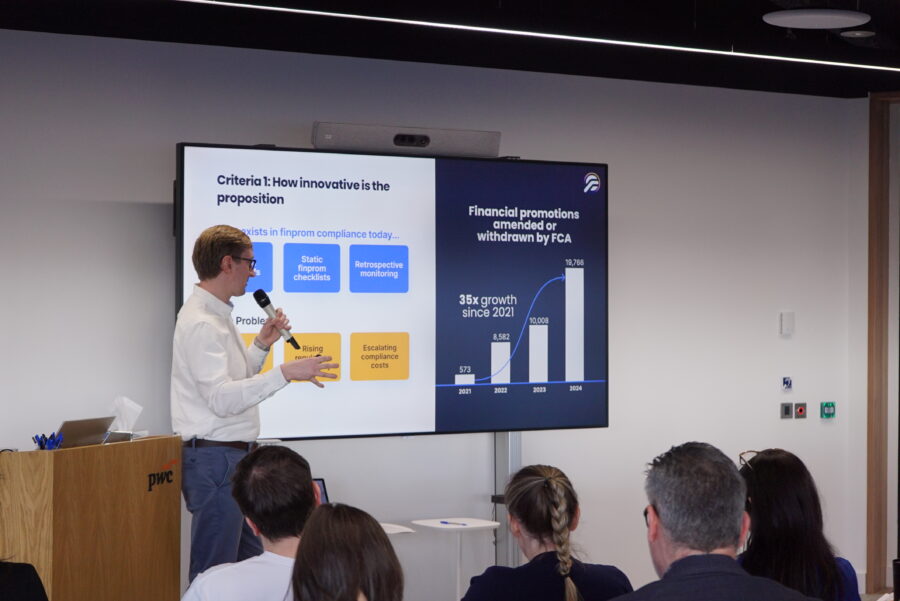
Every time a regulated firm publishes a social media post, launches a marketing campaign, updates a website, or prints a brochure, that content must comply with a dense web of financial promotion rules. In the UK, the Financial Conduct Authority (FCA) oversees this regime, and it’s getting stricter. FCA interventions on financial promotions nearly doubled from approximately 10,000 in 2023 to nearly 20,000 in 2024.[1] Additionally, the introduction of Consumer Duty[2] has raised the bar further, requiring firms to demonstrate that every customer communication is clear, fair, and not misleading.
Yet the tools most firms use to manage this process haven’t kept pace. Compliance teams still rely on spreadsheets, manual screenshot archiving, and subjective interpretations of rules around things like the “prominence” of risk warnings. Over 75% of content typically fails its first compliance review, and sign-off cycles stretch from three days to a full week.[3] For marketing teams producing hundreds of assets per month across LinkedIn, Instagram, TikTok, YouTube, and beyond, this creates an impossible bottleneck.
Finspector was built to break that bottleneck.
What Finspector actually does
At its core, Finspector is an AI-powered platform that automates the review, monitoring, and governance of financial promotions across digital channels including text, images, video and social media.
The key innovation is what we call the rule-to-check engine. Rather than relying on generic keyword scanning or static templates, our platform converts each firm’s unique compliance policies and regulatory obligations into machine-readable, deployable AI checks. For example, a firm might hand us their internal financial promotions checklist, a document that runs to dozens of pages of detailed guidance, and we transform it into a structured set of automated checks that our AI agent can execute against any piece of content in minutes.
This is powered by a combination of large language models, computer vision, and a regulatory knowledge graph developed in partnership with academic partners at the Cambridge Judge Business School spin-out, RegGenome.[4]
The platform operates through four key features.
- Inspect reviews content before publication, flagging potential compliance risks.
- Monitor continuously watches published content across social media channels to catch issues post-publication.
- Approve gives compliance teams a structured workflow for sign-off.
- Audit maintains a complete, time-stamped trail of everything that’s been reviewed, exactly the kind of defensible evidence regulators expect under Consumer Duty.
The practical result is that compliance review times drop from hours to minutes, marketing teams can increase their output without compromising on compliance, and firms gain a scalable oversight framework across every digital channel.
Why the Financial Regulation Innovation Lab mattered
The Financial Regulation Innovation Lab[5], known as FRIL, is a Glasgow-based centre of excellence in financial regulation innovation. It’s a partnership between the University of Strathclyde, the University of Glasgow, and FinTech Scotland, and it has become one of the UK’s most credible programmes for advancing regulatory technology.
Finspector was selected as one of four grant winners under FRIL’s Future of Wealth Innovation Call in 2026, receiving £50,000 to further develop our solution. But to describe FRIL purely in terms of funding would miss the point entirely.
The programme accelerated our development by an estimated three to four months. The grant enabled us to dedicate engineering capacity to core platform features, including the social media monitoring module, the rule-to-check extraction framework, audit reporting, and early ISO 27001 alignment work, that would otherwise have been delayed. In practical terms, it funded approximately 1.5 to 2 additional FTE-equivalents of engineering and product development time across the programme period.
More importantly, FRIL opened doors. The programme’s industry partner network provided warm introductions to senior compliance, risk, and innovation stakeholders at major UK financial institutions, conversations that would typically take three to six months to initiate through cold outreach. Feedback from those sessions was consistently encouraging. Partners described Finspector as a “strong, credible proposition with a clear problem being addressed,” operating in “a good space” with a “reasonable market opportunity.” That kind of validation from tier-one institutions carries real weight when you’re a young company trying to earn trust in a, traditionally, risk-averse sector.
The structured pilot process was equally valuable – we onboarded live pilot clients during the programme, converting compliance policies into automated AI checks and deploying them against real content. One early engagement involved converting two detailed policy documents into 82 separate AI checks, covering jurisdictions spanning the UK, Europe, Australia, the US, Asia, and the Middle East. The feedback loops from these pilots (we tracked 23 distinct feature requests from early users) directly shaped our product development and reduced false positive rates.
Scotland as a strategic base
One of the less obvious outcomes of the FRIL programme is that it crystallised our commitment to Scotland as a long-term strategic base.
This wasn’t a foregone conclusion, Finspector is a UK-wide company, and our team and clients span multiple regions. But the depth of the Scottish fintech ecosystem, the quality of the academic institutions, and the genuine support from organisations like FinTech Scotland and Scottish Enterprise have made a compelling case.
We’ve already appointed a dedicated Account Manager based in Scotland, and we’re planning to bring on interns over the summer to support product development and operations. But the ambition goes well beyond that. Over the next three to five years, Finspector looks to potentially establish a permanent Scottish operational hub, and we’re targeting a Scotland-based team of around 20 by 2029.
Scotland already has a strong reputation in financial services and a growing fintech cluster. Our goal is to contribute to that by positioning the country as a centre for AI-driven regulatory technology innovation, a niche where Scotland can genuinely lead.
What comes next
Since 1 January 2026, Finspector is in active commercialisation mode with an aim of targeting 25 to 40 regulated firm clients over the next 12 to 24 months.
On the product side, Q2 2026 will see the launch of website monitoring and domain-wide scanning, enhanced security controls for ISO certification, and continued platform improvements driven by client feedback. Later this year, we’ll expand social monitoring automation, introduce version control and historic comparison features, and target our first enterprise-scale deployment. International rule libraries covering the EU and UAE are planned to follow, along with API integrations with compliance workflow systems.
We also participate in the FCA’s AI Supercharged Lab and AI Spotlight programmes, giving us a dual regulatory endorsement that few early-stage RegTech firms can claim.
A reflection
The FRIL programme has been transformational for Finspector. We entered with a strong technical foundation, we’re leaving with live pilots, paying customers, and a clear path to scale.
But perhaps the most lasting impact is strategic, FRIL didn’t just help us build a product faster; it helped us see where we should be building it. Scotland’s combination of regulatory expertise, academic depth, financial services heritage, and genuine ecosystem support makes it the right place for a company like ours to grow.
We’re just getting started.
Phil Clements is CEO of Finspector, an AI-powered RegTech platform for financial promotions compliance. Learn more at finspector.ai.
[1] https://www.fca.org.uk/news/press-releases/fca-steps-action-against-misleading-financial-adverts
[2] https://www.fca.org.uk/firms/consumer-duty
[3] https://intelligencebank.com/insights/what-are-the-top-marketing-compliance-challenges/
[5] https://www.fintechscotland.com/research-innovation/financial-regulation/