From innovation challenge to Scottish ambition: How Finspector is building the future of financial promotions compliance
By Phil Clements, CFA, CAIA, FDP, CEO at Finspector
When we incorporated Finspector in March 2025, we had a straightforward thesis: the way regulated firms manage financial promotions compliance is broken, and AI can help to fix it. What we didn’t fully anticipate was how quickly the right ecosystem support could turn that thesis into a live, revenue-generating platform, or how Scotland would become central to our story.
Twelve months on, Finspector has gone from concept to commercial traction, with signed proof-of-concept clients, paying customers, and recognition as FinTech of the Year at the Scottish FinTech Awards 2025. A significant part of that acceleration came through our participation in the Financial Regulation Innovation Lab, and it’s worth explaining why.
The problem we set out to solve
The financial services industry has a marketing compliance bottleneck that most people outside the sector don’t fully appreciate.
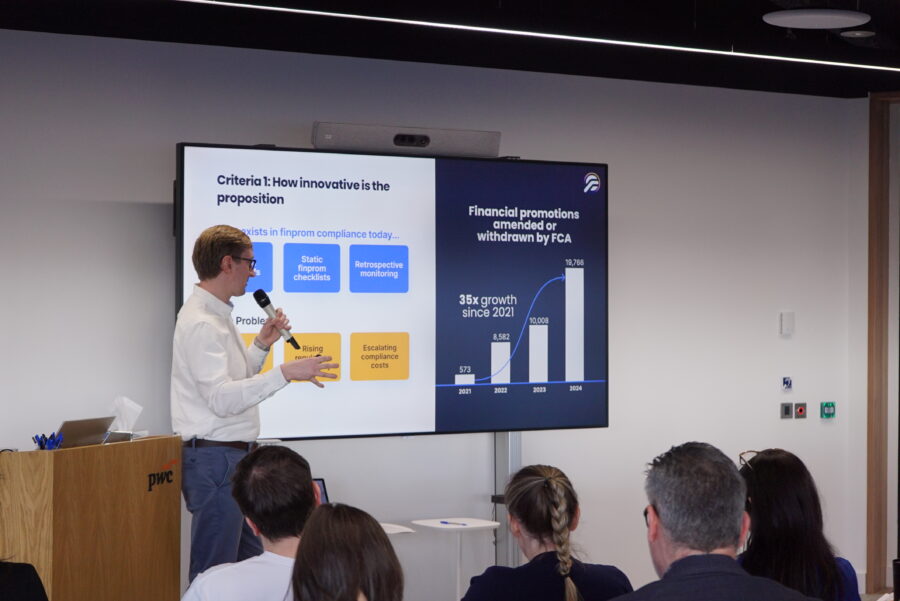
Every time a regulated firm publishes a social media post, launches a marketing campaign, updates a website, or prints a brochure, that content must comply with a dense web of financial promotion rules. In the UK, the Financial Conduct Authority (FCA) oversees this regime, and it’s getting stricter. FCA interventions on financial promotions nearly doubled from approximately 10,000 in 2023 to nearly 20,000 in 2024.[1] Additionally, the introduction of Consumer Duty[2] has raised the bar further, requiring firms to demonstrate that every customer communication is clear, fair, and not misleading.
Yet the tools most firms use to manage this process haven’t kept pace. Compliance teams still rely on spreadsheets, manual screenshot archiving, and subjective interpretations of rules around things like the “prominence” of risk warnings. Over 75% of content typically fails its first compliance review, and sign-off cycles stretch from three days to a full week.[3] For marketing teams producing hundreds of assets per month across LinkedIn, Instagram, TikTok, YouTube, and beyond, this creates an impossible bottleneck.
Finspector was built to break that bottleneck.
What Finspector actually does
At its core, Finspector is an AI-powered platform that automates the review, monitoring, and governance of financial promotions across digital channels including text, images, video and social media.
The key innovation is what we call the rule-to-check engine. Rather than relying on generic keyword scanning or static templates, our platform converts each firm’s unique compliance policies and regulatory obligations into machine-readable, deployable AI checks. For example, a firm might hand us their internal financial promotions checklist, a document that runs to dozens of pages of detailed guidance, and we transform it into a structured set of automated checks that our AI agent can execute against any piece of content in minutes.
This is powered by a combination of large language models, computer vision, and a regulatory knowledge graph developed in partnership with academic partners at the Cambridge Judge Business School spin-out, RegGenome.[4]
The platform operates through four key features.
- Inspect reviews content before publication, flagging potential compliance risks.
- Monitor continuously watches published content across social media channels to catch issues post-publication.
- Approve gives compliance teams a structured workflow for sign-off.
- Audit maintains a complete, time-stamped trail of everything that’s been reviewed, exactly the kind of defensible evidence regulators expect under Consumer Duty.
The practical result is that compliance review times drop from hours to minutes, marketing teams can increase their output without compromising on compliance, and firms gain a scalable oversight framework across every digital channel.
Why the Financial Regulation Innovation Lab mattered
The Financial Regulation Innovation Lab[5], known as FRIL, is a Glasgow-based centre of excellence in financial regulation innovation. It’s a partnership between the University of Strathclyde, the University of Glasgow, and FinTech Scotland, and it has become one of the UK’s most credible programmes for advancing regulatory technology.
Finspector was selected as one of four grant winners under FRIL’s Future of Wealth Innovation Call in 2026, receiving £50,000 to further develop our solution. But to describe FRIL purely in terms of funding would miss the point entirely.
The programme accelerated our development by an estimated three to four months. The grant enabled us to dedicate engineering capacity to core platform features, including the social media monitoring module, the rule-to-check extraction framework, audit reporting, and early ISO 27001 alignment work, that would otherwise have been delayed. In practical terms, it funded approximately 1.5 to 2 additional FTE-equivalents of engineering and product development time across the programme period.
More importantly, FRIL opened doors. The programme’s industry partner network provided warm introductions to senior compliance, risk, and innovation stakeholders at major UK financial institutions, conversations that would typically take three to six months to initiate through cold outreach. Feedback from those sessions was consistently encouraging. Partners described Finspector as a “strong, credible proposition with a clear problem being addressed,” operating in “a good space” with a “reasonable market opportunity.” That kind of validation from tier-one institutions carries real weight when you’re a young company trying to earn trust in a, traditionally, risk-averse sector.
The structured pilot process was equally valuable – we onboarded live pilot clients during the programme, converting compliance policies into automated AI checks and deploying them against real content. One early engagement involved converting two detailed policy documents into 82 separate AI checks, covering jurisdictions spanning the UK, Europe, Australia, the US, Asia, and the Middle East. The feedback loops from these pilots (we tracked 23 distinct feature requests from early users) directly shaped our product development and reduced false positive rates.
Scotland as a strategic base
One of the less obvious outcomes of the FRIL programme is that it crystallised our commitment to Scotland as a long-term strategic base.
This wasn’t a foregone conclusion, Finspector is a UK-wide company, and our team and clients span multiple regions. But the depth of the Scottish fintech ecosystem, the quality of the academic institutions, and the genuine support from organisations like FinTech Scotland and Scottish Enterprise have made a compelling case.
We’ve already appointed a dedicated Account Manager based in Scotland, and we’re planning to bring on interns over the summer to support product development and operations. But the ambition goes well beyond that. Over the next three to five years, Finspector looks to potentially establish a permanent Scottish operational hub, and we’re targeting a Scotland-based team of around 20 by 2029.
Scotland already has a strong reputation in financial services and a growing fintech cluster. Our goal is to contribute to that by positioning the country as a centre for AI-driven regulatory technology innovation, a niche where Scotland can genuinely lead.
What comes next
Since 1 January 2026, Finspector is in active commercialisation mode with an aim of targeting 25 to 40 regulated firm clients over the next 12 to 24 months.
On the product side, Q2 2026 will see the launch of website monitoring and domain-wide scanning, enhanced security controls for ISO certification, and continued platform improvements driven by client feedback. Later this year, we’ll expand social monitoring automation, introduce version control and historic comparison features, and target our first enterprise-scale deployment. International rule libraries covering the EU and UAE are planned to follow, along with API integrations with compliance workflow systems.
We also participate in the FCA’s AI Supercharged Lab and AI Spotlight programmes, giving us a dual regulatory endorsement that few early-stage RegTech firms can claim.
A reflection
The FRIL programme has been transformational for Finspector. We entered with a strong technical foundation, we’re leaving with live pilots, paying customers, and a clear path to scale.
But perhaps the most lasting impact is strategic, FRIL didn’t just help us build a product faster; it helped us see where we should be building it. Scotland’s combination of regulatory expertise, academic depth, financial services heritage, and genuine ecosystem support makes it the right place for a company like ours to grow.
We’re just getting started.
Phil Clements is CEO of Finspector, an AI-powered RegTech platform for financial promotions compliance. Learn more at finspector.ai.
[1] https://www.fca.org.uk/news/press-releases/fca-steps-action-against-misleading-financial-adverts
[2] https://www.fca.org.uk/firms/consumer-duty
[3] https://intelligencebank.com/insights/what-are-the-top-marketing-compliance-challenges/
[5] https://www.fintechscotland.com/research-innovation/financial-regulation/
What is on this page:

Related content

Towards a Fairer Financial System: Insights from Gillian Docherty and Clare Reid

Finance and Health Lab National Conference