
Women’s Coin to launch during Scotland’s Fintech Festival
Blog by (Prof) Christine Bamford Founder and CEO Women’s Coin
Exciting news Women’s Coin is now trading!
Women’s Coin digital currency to launch in September at Edinburgh Fintech Festival and internationally at the United Nations, New York Decade of Womenon 18thSeptember
Women’s Coin operates via Bitcoin blockchain platform, using the Counterparty protocol. Blockchain is the power behind behind digital currency enabling storage of digital assets and smart contracts. Women’s Coin is Money Laundering compliant, KYC (know your customer) and ensures total transparency in its financial conduct. In partnership with Zortrex data security company – Women’s Coin intends to secure investments through military grade data security.
Women’s Coin is not just a digital currency it is a coin of value ”“ transferring profits from the currency into humanitarian support. The profit for purpose ethos sets out to build a better world through micro-financing women owned sustainable businesses. Women’s Coin supports United Nations’ Sustainable Development Goal 5 ”“ Gender equality
Women’s Coin is not just for women ”“ men are also critical to the movement (He for She)
Together we can use the power of the wallet to deliver social change
If you want to learn more about Women’s Coin’s amazing vision and product, (Prof) Christine Bamford is speaking at:
- International Cyber Security Summit – 4thSeptember Edinburgh Napier University
- United Nations, New York ”“ Decade of Women – 18thSeptember
- Meeting of Coin Networking Event ”“ Virgin Money Lounge – 25thSeptember
- Fintech Summit ”“ DIGIT – 26thSeptember
womenscoin.com
@womenscoin#MorePowerToHer #Fintechscotland @KateForbes
A Meeting of Coins!
Blog by (Prof) Christine Bamford Founder Women’s Coin 
For readers who didn’t know ”¦
Scotland is the first country in the UK (possibly Europe) to be home to 2 global digital currenciesWomen’s Coin and Scotcoin! How cool is that!

It can’t be a consequence that 2 digital currencies have emerged from Scotland. It’s the foresight of the Scottish Government, Scottish Enterprise and Fintech Scotland as a hub for innovation in financial technology. Not to mention active support for emergent technologies by Kate Forbes, Minister for Digital Technologies. Who I think is just fab!
Left: Kate Forbes, Minister for Public Finance & Digital Technology, (Prof) Christine Bamford and Dr Jane Lewis, Women’s Coin
Fintech Scotland, Napier University and other key stakeholders such as Virgin Money, Zortrex, Money MatiX, CU Apps and Payment Centric were so welcoming that we decided to establish Women’s Coin here in Edinburgh. There is no doubt that Scotland makes stuff happen and has a real entrepreneurial spirit.
So how did we connect with Scotcoin? Well it’s all down to Fintech brokering service. It took a couple of meetings to establish a trusted relationship but now we feel that there is power in a collective approach
Temple Melville, Director. Scotcoin commented “There was synergy between our coin offerings and a mutual desire to move towards a ICO (initial coin offering) through a legal regulated framework” Dr Jane Lewis, Strategic Director, Women’s Coin added “We have a track record in successful partnership working – So it made sense for us to explore how we might jointly raise our profile and collaborate on trading”
What is Women’s Coin? It is a digital currency for women (& men) with a humanitarian arm using blockchain to deliver charitable giving to the point in need without third party intervention. Every time you use women’s coin payment you support another woman to survive in the most hostile environments on earth. Supporting United Nations SDF 5 (Women’s Empowerment) A coin with a heart
See website http//womenscoin.com
Scotcoin does what is says on the tin. A digital currency for everyone ”“ anywhere!
To celebrate “Coin Collaboration”Fintech supporters will be invited to learn more about our “Coins” blockchain and crypto currencies during September Fintech Festival 9th-27thSeptember
Are You Ready for Blockchain? Collaboration Could be Key
Photo by Hitesh Choudhary on Unsplash
It’s undeniable that blockchain is a complicated and, at times, daunting technological development. Having said this, the opportunities proposed are as exciting as they are complex. From reshaping business transactions to the secure and accurate exchange of data – blockchain has the potential to improve nearly every financial service industry.
This poses an issue of great internal debate for businesses in markets which could truly benefit from the traceability, security and wider potential presented by blockchain.
As a business, should you invest in tech that could ultimately revolutionise your capabilities at the risk of encountering stumbling blocks? Or, do you sit back and watch while others in your sector pick up the early adopter mantel?
Collaboration could be the answer.
Here, we delve deeper into this dilemma faced by businesses considering incorporating blockchain technology into their wider strategy, and help answer the question; is your business ready for blockchain?
What is the impact of blockchain?
Blockchain is far more than just a channel for cryptocurrency and can offer far reaching business applications. Here are some of the key impacts blockchain could have on your business:
- Automation
- Transparency
- Autonomy
- Security
- Reduced error handling
- Member accountability
How can blockchain help businesses?
When considering whether blockchain is a worthy investment for your business, it’s important to consider what its wider applications could be. This technology can provide clear solutions to challenges in wide-ranging sectors. However, as a business owner, you need to be sure that the investment will benefit your company.
Here are just a few ways blockchain could benefit your business:
- Shared data across several participants or external parties
- Access to edit or update information needed by multiple participants
- Recorded verification and security of participants and users
- Reduction of cost through decentralised record keeping
- Time sensitive information sharing and updates
- Instant, interactive transactions between different participants
- Improved capital optimisation
Should you consider blockchain for your business?
No one is disputing that blockchain is going to become increasingly influential over time. Having said this, it simply isn’t needed by everyone at this stage. If you’re sitting on the fence, there are many points to consider.
Blockchain shouldn’t be considered as an aspiration to achieve for your company. It’s an enabler to aid in the efficiency or cost reduction of your existing processes. Don’t position this technology as a capability which validates your business’ proposition. Instead, it’s a tool to improve your business models and dealings with other companies. If it’s not addressing a current issue or opportunity, it simply isn’t for you at this stage.
Finding your opportunity
Monitoring the way distributed ledger or blockchain technology is used in similar industries is a great place to start when seeking potential opportunities. It’s important to be aware of any competitors who attempt to leverage this tech before you as it may leave you at a serious disadvantage later on.
Consider whether your business could work smarter’ using blockchain and whether you can leverage enough influence to truly benefit from doing so.
What Can EEN Offer Your Business in Terms of Collaboration?
Enterprise Europe Network (EEN) provides a network of specialist support to help companies do business in Europe and beyond. From helping with access to funding to finding trusted partners, EEN can help your business grow internationally.
Here’s how EEN can help:
- Improve the way you manage innovation
- Track down long-term finance from public and private sectors
- Provide a network of world-wide advisers
- Help you find trusted partnerships
- Help you expand into new markets and countries with help from local experts
- Expand and scale-up your business
With hundreds of collaborative partnership opportunities available, EEN allows you to search for SME and academic business partners to develop your products, ideas and services.
Current Opportunities with EEN
Here are some examples of live opportunities available through EEN:
- A UK business is offering a blockchain based employee background checking toolkit to make employee checks more efficient.
- They are looking for organisations that are seeking improvements using automation, candidate experience, candidate privacy and modernising employment checks.
- A London company has developed a next generation private, permissioned blockchain development platform. The platform enables businesses to take advantage of the benefits of the blockchain and apply them to business solutions and applications.
- They are seeking partners to sign commercial agency and license agreements across a wide range of industries to pilot test their built platform.
- A London based start-up is seeking a software developer with relevant technical skills in AI, ML and Blockchain to develop a professional social media and communication cost centre management platform.
- The business wishes to develop service agreements with businesses possessing the technical expertise that will help the company to realise its vision of disrupting technology in the healthcare industry.
- A Portuguese SME specialising in software as a service (SaaS) solutions for fintech and business communication is looking for partners to cooperate under a commercial agency agreement.
- This SME is interested in commercial agency agreements with international partners to pursue their scale-up strategy in European and non-European markets.
How to ensure you’re ready for the implementation of blockchain
Is your business ready to begin blockchain implementation?
There are several factors to consider;
- Commercial gain – is there a value to be taken from this technology?
- Compliance – will this technology comply with the regulations your business is required to meet?
- Execution – do you have the right skills and resources to actually make this work?
- Technical capabilities – can the technology be seamlessly integrated?
- Transparent operations – have you planned a fair and transparent way of governing the wider operational aspects of integrating this technology?
Partnership Opportunities in Blockchain
Enterprise Europe Network (EEN) helps businesses to find global partnership opportunities with SMEs or academia to help manufacture, develop and supply their products, ideas and services. If you’re considering implementing this technology into your business, explore EEN’s blockchain partnership opportunities.
Scotcoin presents Social Bite with a cheque for £1k.
On 24th May at the Rose Street HQ of Social Bite, Temple Melville, Director of The Scotcoin Project CIC will present a cheque for £1000 to Andrew Baillie, Social Bite’s Partnership Manager, who said,

“Social Bite is delighted to receive £1000 from the team at Scotcoin. We will use this generous donation to provide dignified meals, supportive employment and sustainable housing for people who have been affected by homelessness across Scotland.”
Scotcoin wants to join the citywide alliances aiming to eradicate homelessness in Edinburgh and Scotland and Social Bite’s model fits perfectly with the values and ethos that Scotcoin Project prioritises. Temple Melville said,
“ I’m delighted our initiative to raise funds for Social Bite has worked so well. We intend to increase our efforts within the charity ecosystem, and are working with Andrew Baillie to enhance our efforts.”
About Social Bite Social Bite is a Scottish social enterprise set up by Josh Littlejohn MBE and Alice Thompson. The organisation is run on a not-for-profit basis and a quarter of the company’s staff are from homeless and severely excluded backgrounds
Website:https://social-bite.co.uk/
Email: andrew.bailie@social-bite.co.uk
About Scotcoin
Established in 2013, Scotcoin is one of the first and most successful country related crypto-currencies on the market to date. Achieving widespread adoption in 2014 it continues to grow with over 3,000 holders globally, it currently utilizes the power of the Bitcoin blockchain.
Scotcoin originated in Scotland, of which it is extremely proud but this currency it global and not just limited to Scotland. It is envisaged that Scotcoin will be used by many people across the world for transferring wealth, goods and services within its new fully decentralized self-sustaining economy.
Website:ScotcoinProject.com Email: temple@scotcoinproject.com mylesgeddese@gmail.com
Mi Rewards: the first card-linked, city-wide loyalty scheme. Here’s how it works
In 2018 we launched Mi Rewards, the cardless, city-wide loyalty scheme, in Perth. It’s the first UK scheme to offer rewards that can be earned and spent across a town or city.
Mi Rewards is unique: consumers don’t need a loyalty card or app. They link their payment cards to the programme and, when they spend in participating businesses, they are automatically rewarded.
Over 2600 consumers and 60+ businesses have signed up. So how and why did we develop Mi Rewards?


Miconexhave nearly a decade of experience working with UK towns and cities on digital communication and local currency programmes. We manage a successful Gift Card programme with Perth & Kinross Counciland we’ve helped nearly 30 other cities and regionsto replicate this model.
Next we wanted to add a town/city rewards scheme, to:
- encourage shopping in the city;
- stimulate additional spend;
- better understand and communicate with customers;
- develop new consumer communication channels;
- measure the impact of events, marketing and planning decisions.
The main issue with traditional town and city loyalty programmes is that the consumer has needed to identify themselves at the point of sale. This means that either all staff in all the businesses require training or that additional hardware/software is required (expensive and unwelcome). We had to remove this friction.
Following extensive research, we concluded that payment-card-linked technology would remove the barriers. We partnered with Stampfeet, Perth and Kinross Council’s City Centre Management Team and a steering group of Perth businesses.
“Stampfeet has vast experience with card-linking technology, and our flexible loyalty platform supports the requirements of a city-wide scheme. We were excited about delivering an excellent product with a great vision.”
Asaf Rozin, Stampfeet CEO
Our proposition provides a frictionless solution:
- Automatically rewardsparticipating customers;
- No joining fee;
- No staff training, additional hardware/software;
- Cost to business is 1% of qualifying transactions;
- Points are converted into Perth Gift Cards.
This is highly attractive for consumers and businesses. Once they have registered for the programme the rest of it works automatically. We reward our customers just as Tesco and Nectar do ”“ but without a loyalty card. Mi Rewards and the businesses benefit from data insights into consumer behaviour; we are essentially creating a “single view” of a consumer across a whole network of businesses.

“Mi Rewards allows Place Managers to better understand how people engage with towns and cities and how we can adapt to satisfy evolving consumer preferences. We can improve residents’ experiences and the local economy.”
Leigh Brown, Chair of the Association of Town and City Management and City Centre Manager at Perth & Kinross Council“I love that Mi Rewards encourages people to shop locally. And it doesn’t pitch one business against another but rewards customers for shopping with us all.”
Dawn Cotton Fuge, owner of Precious Sparkle
We now have 2600 Mi Rewards users (1400 of those have linked at least one payment card). We’ve tracked over £100,000 of local spend to date, gaining powerful insights into retail trends. To engage customers further, we introduced “Points, Perks & Prizes”, where they earn points, win prizes or get perks, e.g. exclusive discounts and offers.
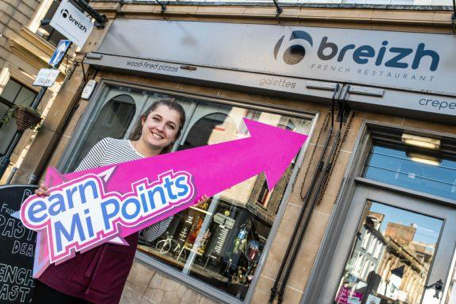
How it works
Because Mi Rewards is cardless and requires no additional software, hardware or training, it’s easy to use. Consumers register at Mi Rewardsand link their payment card(s). Businesses register at Mi Rewards Business. Shoppers are rewarded with pre-loaded credit cards (e.g. a Miconex Gift Card) to spend in registered businesses.
Moving forward
We’ve recently partnered with Stagecoach Group to offer Mi Rewards to bus users. We will also shortly introduce mobility tracking apps which will reward people for walking/cycling into the city centre.
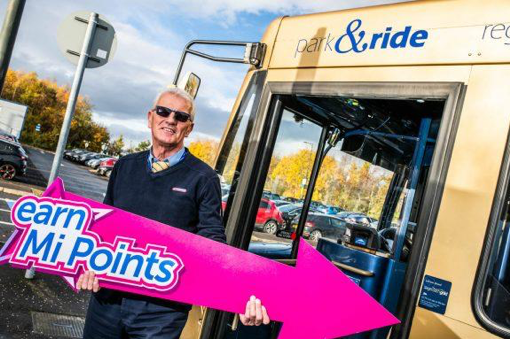
Mi Rewardsallows us to communicate more effectively with consumers, gain insights, reward loyalty and encourage healthier living. We’re in discussions with many towns and cities about the UK/Ireland programme rollout. We believe that Mi Rewardsis the future of town/city loyalty.
Contact
Colin Munro, Managing Director, Miconex
01738 444376
colin@mi-cnx.com
The dangers of cashless and how to design for a digital economy
Blog written by Sergei Miller-Pomphrey – analyst, designer, full-time finch nerd – @goforsergei on twitter and medium
Many have recently spoken about the dramatic cashless uptake by consumers. June 2018 was a big month with the breaking news that UK debit card transactions had overtaken cash transactions for the first time (13.2bn transactions compared to 13.1bn)”Š”””Šreported in various media, examples here, hereand here”Š”””Šand contactless transactions (5.6bn) had grown dramatically, also.
In terms of debit cards, the uptake is an outcome of many factors like fewer branches and cash machines, but probably most prominent is the general cultural shift toward using cash less frequently and leveraging the efficiencies that card transactions bring.
As for contactless, this has been made possible in part by the enhancements made to UK bank cards”Š”””Šall new cards printed in the last several years have generally been contactless-enabled, barring a few slow off-the-mark legacy banks, with the earliest contactless adopters going back a decade (and longer if you’re a real pedant).
Contactless debit cards coupled with smartphone ubiquity, the rise of smartwatches, and Apple, Google and Samsung Pay enabled on almost every device, has made paying by some form of cashless payment easier.
Not to mention the meteoric rise of internet shopping, which now goes beyond buying books and small electronics, with everything available online from food and clothing to holidays and cars.
Also, Direct Debits are now so standard it’s hard to imagine that there ever was a time when you got a physical bill from a supplier and you went to the Post Office to pay it!
(Many) Users are obviously embracing contactless and a cashless economy.
But none of this could have been made possible without merchants evolving to accepting cashless payments as a standard, also.
Your local coffee shop these days is as likely to have a sign that says “No Cash” as it was a decade ago that the sign read “Cash Only”.
The challenge
Let’s cut to the chase”Š”””Ša cashless economy requires democratised, stable and secure infrastructure.
Users need the ability to engage in a cashless economy, which means they need bank accounts to get debit cards and smart-enabled devices to pay for things cashlessly.
Getting a bank account means you need proof of identification and a fixed physical location to call a home.
Even mobile numbers and email addresses are mandatory in many instances these days when applying for a bank account, which means you need a home landline or mobile phone contract and some form of internet access.
And all of that is just for the consumers”Š”””Šbusinesses that rely on cash and cheque need to invest in business bank accounts that generally charge the business a monthly fee and additional fees for transactions, payments, deposits, withdrawals.
Businesses need EPoS machines (electronic point of sale”Š”””Šcard readers) to take payments. In order for card readers to work, they need internet. EPoS vendors can charge monthly fees, flat percentage fees on transactions, or varying tiers depending on value or number of transactions.
Then comes the underlying payments network infrastructure. Mastercard and Visa, the two biggest players in the game”Š”””Šcheck your bank cards, their logos are likely on them! (With American Express being another biggie.)
Last year, in June, the Visa network went downall across Europe. It was a pretty crazy day.
Then, a month later, Mastercard went down.
With the growth in cashless payments, these down times were felt by consumers hard ”“ people were rushing to cash machines to withdraw funds to pay for dinner, buy shopping, go out, or even just manage to make it home safe from wherever they were.
It exposed just how reliant we are, now, more than ever, on systems rather than people. When working in hospitality. If you’re working in a café and your till system goes down, you just have to use a piece of paper, a pen, and a calculator, and you take cash only.
There was no alternative here for those that didn’t already have cash on them or who couldn’t get to a cash machine.
In the grand scheme of things, a few hours of payment processing being down is manageable”Š”””Šthink about how we manage power cuts and bus replacement services, we just need a back-up infrastructure.
At the moment, that backup infrastructure is cash. But this may not always be.
Cash and cashless
Cash
One of the huge benefits of cash and the physical economy is that it is democratised for, of and by the people ”“ you don’t needa bank account for cash, you don’t need a home, you don’t need a driving license, Council Tax bill, phone number, email address or passport.
While some may have more or less money than others, nobody (practically) owns money or the cash economy itself”Š”””Šregardless of who prints the money.
Another huge benefit is that you don’t need a technical infrastructure”Š”””Šcash is good old brain and brawn (counting and moving).
If there’s an issue with a register, EPoS machine or calculator, you can always just figure it out yourself.
Cashless
In essence, many of the benefits of cashless are just the negative points of cash”Š”””Šlike all good evolving innovations, cashless is finding and fixing the weak(er) points of its predecessor.
Cash is physical, so it’s SUPER dirty”Š”””Šit’s pretty disgusting when you think about it.
Cash is physical, so it’s fragile”Š”””Šthe number of times I washed my last fiver while in school makes me want to cry just thinking about it. Or that ripped £20 that you taped back together so you could top up the leccie card and keep the lights on!
Cash is physical, so it goes missing”Š”””Šremember looking all over the house for the tenner that fell out when you emptied your pockets that night?
Cash is physical, so it takes up space”Š”””Šall those times you walked down the street with your pockets sounding like the unmistakable jingle jangle of a high-school janitor!
Holding cash can bring risk.
You could be mugged in the street for the contents of your wallet, if you’re lucky, or sustain injuries or worse if you’re unlucky that day.
Your business could be burgled, losing a day or week’s or month’s takings depending on how often you get to the bank.
One big point about digital however, is that it is every bit as susceptible to theft as hard cash.
The difference being that we now put even more of that burden of protection on the organisations that hold our cash, in exactly the same way that we did when banks first started operating.
The pros of cashless essentially boil down to three things, efficiency, security and convenience.
The bigger issue
System infrastructure is one thing, but socio-economic infrastructure is another, much more difficult issue altogether.
There has been a lot of discussion about two main things to do with the negative effects of a cashless economy (with, of course, many other issues and nuances, also):
- Inherently denying access; and
- Hurting businesses that rely on cash
Let’s take them in turn.
Access
The first part of the infrastructure outline above should act as a warning bell to every one of you reading this”Š”””Šhow do the homeless, those who can’t prove their identity, those without access to internet, the unbanked and the underbanked gain access to the cashless economy?
Access to the cashless economy is a privilege.
Cashless is inherently baking additional privilege in to the world’s economies.
This additional privilege thereby adds more disadvantage those who are already hugely disadvantaged and deprived in our societies to start.
With cashless adoption growing, there’s less need for a physical infrastructure such as bank branches or cash machines (though, of course, more reliance on an network of card readers).
This has negative effectson those who rely on those services, which invariably includes the poor, the elderly, the not-digitally-enabled, the un- and under-banked, and those who just don’t know how to manage their finances, digitally, or engage in the system.
There are many, many, manyarticles to read on the subject.
Business
The second part is about how micro and small enterprises can survive in a cashless economy.
Part of the reason for this struggle is due to cash flow.
Businesses that rely heavily on cash and cheque transactions are able to manage their cash flow more easily against low turnover.
For example, if a cheque takes a few days to clear, then they can write the cheque on the Friday but use the takings from the weekend to pay for the cheque come Tuesday.
Other issues include the additional overheads that businesses need to absorb in order to engage in a cashless economy”Š”””Šphone line, card reader rental, fees on transactions, all of that needs to either come off the business’s bottom line or be put on to the consumer.
The future of cash
Cash will die. Eventually.
Just like the horse-and-cart are no longer the primary mode of logistics and transportation, and the quill is no longer the prevalent form of writing implement”Š”””Šcashless is the evolutionof cash.
It is inevitable.
Now, it may not happen tomorrow or in the next decade. Cash still has some fight in it yet, but that isn’t necessarily down to any inherent traits in the benefits of cash.
The necessity of holding on to cash actually comes from the sheer scale of the culture change required and our failures in being able to adapt quickly enough to build for a cashless economy that was peaking over the horizon for the last decade.
Let us re-frame and reverse a position above”Š”””Šcashless does notinherentlydeny access to the economy.
Cashless doesn’t think. It’s not a thing or a person. It’s a concept. It’s a culture. And it’s a culture born out of the real world and how people interact.
And those that are denied access to the cashless economy is not because of those that are engaging with it, but because financial institutions have not solved access to the economy for those people.
For those that don’t have access to internet, this is due to government and big telcom not having solved issues of access as a right for the populace.
The last one is more difficult”Š”””Šfinancial literacy and awareness, in being consciously able to adapt and embrace a cashless / digital economy. That’s huge culture change and the government and banks and all financial institutions should be working together provide access to information and knowledge that can help these people engage.
And businesses, how do we help them?
Well, part of this isn’t cashless’s fault, again. High-streets all across the UK are being squeezed because of online shopping and changing demand.
Cashless is only one part of a larger trend for businesses and they need to adapt their business models regardless of whether they take card or not.
But they must know that if the trend is leaning towards cashless payments, then they risk losing customers if they can’t accept this payment.
And as for managing suppliers and cash flow, there are ways to re-set yourself there, too”Š”””Šbusinesses need to recalibrate to be able to hold cash for future payments, not pay yesterday with today.
So, what..?
Well, we need to do something about it.
And by we’, I don’t mean consumers. I don’t mean that they need to shop local, ignore online retailers, and hoard cash under their mattresses.
Consumer trends are consumers voting with their feet and the economy needs to react to them, not attempt to control them.
The worry here is that government may impede progress by placing regressive policies on consumers or businesses, instead of acknowledging that change is needed and pushing onwards.
It’s always better to fix forward instead of policing back.
We need to have some form digital economy design council that coordinates and aligns financial institutions, businesses, consumers, and most importantly, government.
We need to agree that access to the digital economy is a right, not a privilege.
If we agree that access is a right and not a privilege, it changes how we frame the issue.
It becomes a social imperative to provide access, just like health, education, security, and infrastructure, rather than putting the blame on consumers and changing habits.
Then we can begin designing forward, finding ways to include individuals that are excluded or at risk of exclusion by the many criteria out there.
Maybe we could increase and speed up government incentives for telcoms to provide internet and cellular infrastructure to those in remote or rural areas?
Maybe financial institutions could leverage their Corporate Social Responsibility policies to provide low-cost starter’ smart-enabled devices to allow those without a mobile phone, a computer, internet, or even a branch to access their bank account?
Maybe financial institutions could provide starter’ bank accounts for immigrants, vagrants, and transients?
Maybe government can create a basic account associated to your national insurance number so that every single citizen has basic access to some form of bank account?
Maybe that could be provided in collaboration with a challenger bank like Starling, who have an infrastructure built for the modern economy?
Maybe.
Maybe.
Maybe.
None of these issues are easily solved, but the conversation needs to be had to start trying to solve them.
Thinking forward instead of back is the key to how we can solve this and build for the inevitable digital economy.
But the first step is to think at all.
Previse named as one of the hottest fintechs in Europe
Previse, the global instant supplier payments decisions company with an office in Glasgow, has been recognised as one of the hottest fintechs in Europe by Fintech50 at an exclusive ceremony in London on Wednesday 20 June.
The Fintech50 is a prestigious list of the top fintech companies in Europe, chosen by an expert panel of leaders from around the world, representing investors, financial organisations, global techs and innovation leaders. Previse was selected from over 1,800 fintechs from all over Europe.
In choosing the final 50, the judges look for companies with a track record as well as growth potential for the future. The list included Revolut, the retail FX company which this year was valued at over £1 billion, as well as a number of well-known fintechs serving institutional investors.
This is the latest in a year of positive announcements for Previse. The company opened a new Glasgow office in October 2017, secured R&D funding from Scottish Enterprise and appointed business heavyweights David Tyler, Chairman of Sainsburys, and British Land Chairman, John Gildersleeve, to its advisory board. It also announced partnerships with the leading provider of digital supply chain solutions, Virtualstock, and social enterprise, Auticon.
Earlier this month, co-founder and CEO of Previse, Paul Christensen, was appointed to Innovate Finance and City of London Corporation’s Fintech Strategy Group. The group has been tasked with driving the success of the world-leading UK fintech sector.
Paul Christensen, CEO and co-founder of Previse said: “We are pleased to be included in this prestigious list of the hottest fintechs in Europe. Being selected out of a pool of 1,800 companies is strong validation of the importance of the slow payments problem we’re solving, how we’re solving it, and our tremendous team.
“Slow supplier payments are damaging the world economy. Every year hundreds of thousands of businesses which are fundamentally sound, creating good jobs and with potentially transformative ideas and products close purely as a result of their cash flow challenges.
“Previse solves this problem by enabling corporate buyers to pay suppliers of all sizes, instantly, making slow payments a thing of the past. We use hundreds of millions of data points and sophisticated artificial intelligence algorithms to provide a score of a corporate buyer’s likelihood to pay the invoice. This allows funders to instantly release funds to the supplier to meet the invoice. Suppliers get cash on delivery. Widespread adoption of InstantPay will have a major positive impact on the economy.”

Previse’s expansion in Scotland. Interview with the Chief Product Officer
Earlier this month we received some great news from Previse. The B2B payment decisions start-up managed to secure £800k R&D grant from Scottish Enterprise in order to to set up an new development centre in Glasgow, creating 37 new data science jobs.
FinTech Scotland spoke with David Brown, Previse’s Chief Product Officer to understand the decision process that lead to the firm’s move this side of the border.
How did Previse come about?
We identified that current solutions to financing trade finance assets involved too much process change and this change more often than not would lead to the demise of payments in the supply chain as most focused on the Top suppliers i.e. the 80/20 rule. The majority of any major corporate spend is with the top 100-200 suppliers, the remainder [referred to as tail spend] can involve thousands of smaller suppliers more often than not most SME’s would fall within this segment. Previse identified a huge gap in the current market offerings and their failure to address this segment and have now developed a solution specifically to address SME payments within the Global Supply chain using, with virtually no process change to deploy.
Why did you choose Scotland to establish your new base?
After meeting with the Scottish Enterprise, Datalabs and the university professors, we came to the conclusion that the right building blocks are being put in place to address the skills gap that is required to enable a digital world and from there a fintech solution.
And why did you choose Glasgow specifically?
This was perhaps the hardest of the decisions but based on the fact the JPM, Barclays and MS have their operations in Glasgow, helped in our final decision.
Where would you like to see improvements in the Scottish fintech proposition?
Fintech in our opinion involves several key ingredients; technology, liquidity and legal without this it could become just tech. It is important that whilst we challenge the use of new technologies, we also challenge our legal frameworks and boundaries to ensure the asset is attractive for finance. Active collaboration between all parties is necessary and should be without conflict as the outcome benefits all.
In your opinion what is the biggest challenge Scotland is facing when it comes to becoming one of the leading fintech hubs?
References. We need strong case studies as change is hard but once you get through the inertia of change it becomes the norm. Scotland must collaborate, promote and get behind platforms, to generate the need and desire for talent, after all this is a new world with new challenges but also amazing opportunities to build world class talent and present a showcase of successful reference accounts to build upon.
Can you tell us about some exciting developments at Previse?
We are in the final stages of some major announcements both in partnerships and in client adoption and are busy hiring in Glasgow to support our growth. Partnering is key to Previse as we have built an enabler and each partnership we announce confirms our strategy and validates our vision.
You told us previously you’d like to spend more time in Scotland. What are the thing you enjoy doing/visiting when you’re up here?
Now I am here after working away for close to 30 years, I am looking up and finding everyone that meant something to my life and growing up, so catching up with neighbours, school and work friends and ex work colleges etc. is top on my agenda.
Are you planning on moving permanently to Scotland?
You never say never and I would like to think that is possible at some stage, I may need help with my Wife Sammi.
You told us previously you’d like to spend more time in Scotland. What are the thing you enjoy doing/visiting when you’re up here?
One of my best friends is Colin Barr who happens to own the Bierhall in Gordon Street so it would have to be that one.
What’s your favourite place in Scotland?
Loch Lomond, I have fond memories of my childhood and swimming there and also my big sister Ireney had her ashes spread there so it is now a very special place for all of us.
Bitcoin vs. Scotcoin – the Scottish cryptocurrency alternative
It’s becoming very hard to ignore cryptocurrencies. Whether you’re a cryptocoin enthusiast or a confirmed sceptic, it’s clear that they are here to stay. They might never replace traditional currencies but will have their part to play in the world of finance.
However, Caroline Wylie, at Scotcoin tells us that the rise in Bitcoin has had a profound effect on the very nature of Bitcoin. Increased transaction charges are pushing up the cost of working in cryptocurrencies – as she says: “Your cup of coffee at £3 looks rather different when it becomes £7 by the time you pay for it. Why would you pay such a high premium just to use Bitcoin as a currency? It makes smaller transactions completely uneconomic.”
Bitcoin Transaction charges
Why are the charges so high? It’s down to the success of Bitcoin. This has led to a steep increase in the number of transactions. The way Bitcoin verifies those transactions requires rewards for the miners who do the work – they get paid in Bitcoin, so the more transactions there are, the more miners are needed and transaction fees go up.
The standard charge for a transaction is 0.0005 BTC or 0.50 cents at $1,000 per BTC. This number can fluctuate depending on how fast you want the transaction to happen.
However, today, with Bitcoin over $11,000, even if the standard charge is around $3.50 it will require 99 blocks to process and confirm the transaction. 99 blocks is the equivalent of up to 17 hours. If you want the transaction to be faster you’re looking at:
0.0006 BTC or $4.20 for 15 blocks
0.0007 BTC or $4.90 for 2 to 5 blocks
The alternative – Scotcoin
Scotcoin intends to move from the Bitcoin blockchain to its own permissioned blockchain to remove the those high transaction charges and speed up how fast those transactions are confirmed. The new blockchain can deal with transactions in seconds with a cost that’s only a very small fraction of the charge one would pay with the Bitcoin blockchain. So not only is it cheaper, it’s faster making retail use of cryptocurrencies a reality.
Scotcoin has already done a small trial of using digital currencies to buy beer in the Arlington Bar in Glasgow. And initial tests on the new blockchain are producing exciting speeds. More updates soon.
About the author:
Scotcoin is a cryptocurrency established in 2014 by Derek Nisbet, a Scottish fintech entrepreneur. It currently operates on the Bitcoin blockchain using the Counterparty protocol and has a market value of $25 million USD placing it in the top 200 of global crypto currencies as measured by the USD value.
In 2016 all intellectual property associated with Scotcoin was acquired from Nisbet by Scottish fintech investors, David Low and Temple Melville.
The investors’ desire is for the Scottish Government to adopt Scotcoin as the country’s unofficial crypto currency. It is acknowledged that currency is not a devolved responsibility whilst Scotland remains part of the UK. Scotcoin could only become an official currency if Scotland was independent of the UK or current legislation was changed.
Blockchain breakthrough for Strathclyde Business School
Another breakthrough from the Strathclyde Business School in collaboration with the National Physical Laboratory, the Toronto Stock Exchange (TMX), and consultancy firm Z/Yen. They managed to timestamp financial stock trades with an atomic clock.
Over 20 million transactions were timestamped by The Atomic Ledger’ project during three hours of trading.
Director of the Strathclyde’s Centre for Financial Regulation and Innovation, Daniel Broby and his team will now analyse the results.
Mr Broby said: “The role of distributed ledgers and precision timing is becoming ever more relevant as Fintech companies adopt blockchain for financial transactions.
This is an exciting trial that will have real world policy impact.
It is at the cutting edge of both finance and technology, helping make money payments over the internet cheaper, faster and more efficient.”
Different processing speeds, server capabilities and execution code are today leading to orders arriving at a market place at different times.
However, current regulatory guidance implies that trades need to be recorded in microseconds (a millionth of a second).
The Atomic Ledger’ project test went beyond microseconds. The Project was able to provide nanosecond resolution.
It is believed the results will provide a benchmark to incorporate the concept of timing into financial asset price discovery.