
EedenBull and Mastercard Asia Pacific partnership
Mastercard and Scottish fintech EedenBull have announced the extension of their strategic partnership from Europe to the Asia Pacific region to support the fintech’s new digital platform launch. The platform will allow banks and businesses to process spending and payments more efficiently.
Building on a partnership in Europe, this relationship will enable Eedenbull to tap into opportunities in the Asia Pacific business-to-business payments market.
For banks and their business customers, the new service provides innovative commercial payments services, including EedenBull’s spend management platform Q Business® that offers a sophisticated yet easy-to-use solution to digitise the slow and costly processing of checks and cash. With Q Business now offered by a network of banks in the Nordics, more than 10,000 registered businesses are benefitting from the process efficiencies and control of spend provided.
Yunsok Chang, Executive Vice President, Market Development, Asia Pacific, Mastercard said:
“Following Europe, Mastercard is delighted to partner with EedenBull in Asia Pacific and to support its unrivalled expertise to leverage the commercial payments space in the region. With Mastercard’s leading advisory experience, sophisticated commercial solutions and wide network of customers and partners, Mastercard will be able to help EedenBull thrive in this market of significant opportunities.”
The extension of the partnership beyond Europe is a testament to Mastercard’s strategy of working with fintech firms to drive innovation and create opportunities for other partners in the Asia Pacific region. As a frontrunner in payments technology, Mastercard is continuously developing new solutions catering to the evolving demands driven by rapid digital transformation.
Nicki Bull Bisgaard, CEO of EedenBull said:
“At EedenBull, we uniquely combine specialist commercial payments expertise with tech-savvy talent, making us the ideal partner to banks. While payment products and services are now more user-friendly, product management is growing more complex and requires access to specialists in marketing, revenue management, IT, legal, regulatory and many other areas. Selecting Mastercard as our preferred partner to support us in creating real value for our partner banks and their customers and to support our expansion in Asia Pacific was easy as we share the same view on what businesses require and how we can best meet those requirements in an ever-changing world.”
Significant Funding Boost for Scotland’s FinTech Cluster
The growing international role of Scotland’s fintech cluster was given a further significant boost today with the announcement of £22.5 million innovation funding for the Global Open Finance Centre of Excellence (GOFCoE) to be established in Edinburgh and the Central region.
The news was confirmed by UK Research and Innovation, the Government research funding agency, as one of seven proposals being funded by the Strength in Places Fund aimed at supporting innovation and economic growth.
GOFCoE will provide a trusted environment for participants from around the world to research and develop innovative solutions aimed at delivering social and economic benefits through open banking and financial data.
For example, the initiative will present opportunities to conduct research into public earning, spending and saving to allow innovative enterprises to create citizen focussed financial services as well as enable policy makers to understand the economic and social impact of policies and regulations before implementing them.
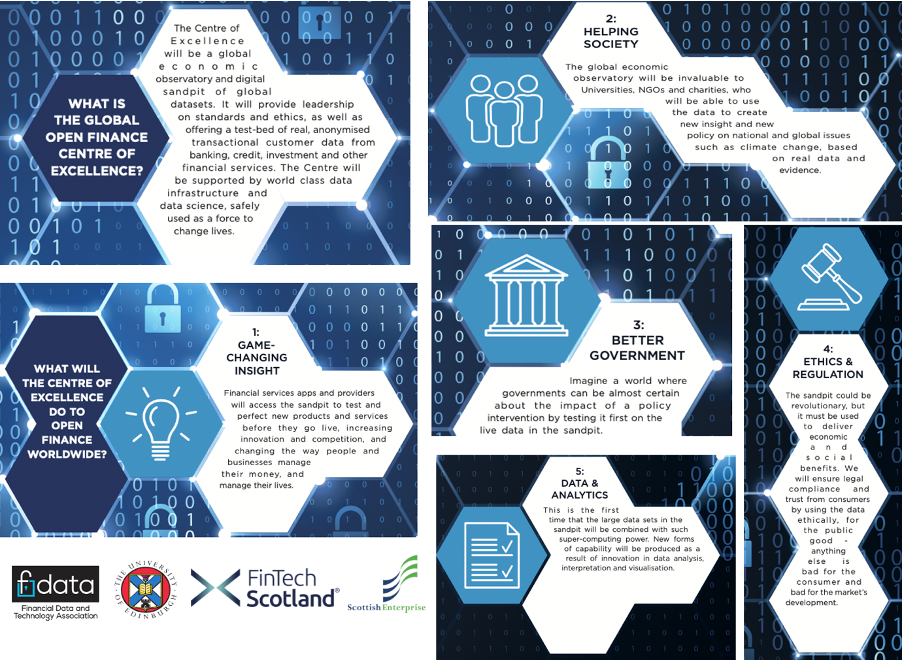
The ground-breaking concept and the development of the initiative over the last two years has been led by the University of Edinburgh, FinTech Scotland, the Financial Data and Technology Association (FDATA) and Scottish Enterprise with the support of a broad range of organisations.
The announcement will further bolster the global recognition of Scotland’s fintech cluster, following on from the formal European cluster excellence accreditation earlier this year, by providing the opportunity for greater research and development in financial innovation to support sustainable economic development.
Commenting on this news, Stephen Ingledew, Chief Executive of FinTech Scotland said,
“The news reinforces the value of cluster collaboration between the diverse range of entrepreneurial enterprises, academics, large institutions, government and citizen groups in embracing the role of data in driving financial innovation to benefit all.
With engagement across Scotland, UK and globally, the initiative will further reinforce the inclusive international approach in developing the fintech cluster which is focused on delivering better consumer financial outcomes and sustainable economic growth through innovation.
I would like to pay tribute to my colleagues Kevin Collins and Damien McGarrigle of University of Edinburgh, Gavin Littlejohn of FDATA , Nicola Anderson of FinTech Scotland along with the rest of the GOFCoE project team for their terrific leadership over the last couple of years in securing this funding opportunity.”
Ivan McKee, Minister for Trade, Investment and Innovation, said:
“I have had the pleasure of working with all of the proposals from Scotland in this competition. Each one demonstrates our appetite for innovation and desire to translate this into benefits for people and places across Scotland.
“I am delighted that the Global Open Finance Centre of Excellence is one of the two projects from Scotland that have received funding from this highly competitive fund. This project will unlock the benefits of open banking and will enhance Scotland’s position as a top destination for fintech.”
The University of Edinburgh’s Senior Vice-Principal, Professor Jonathan Seckl said:
“Using real financial data for social good and allowing governments, companies and people to make better economic and financial decisions is at the heart of the Global Open Finance Centre of Excellence.
Never has there been a time of greater need for data-driven insights into the UK economy. The award from the Strength in Places Fund will allow us to make a unique contribution to the economic recovery from Covid-19. The Centre will be a world-first, providing leadership, coordination, research and capability to develop the benefits of Open Finance and to safely unlock the potential of customer data as a force to improve lives.”
Philip Grant, Chair of Scottish Financial Enterprise, said:
“This is great news for the continued development of the fintech cluster in Scotland and a credit to all the partners involved. The collaboration so evident in this initiative is now recognised as the driver of the continued growth and success of financial services as an important part of the Scottish economy.
SFE and our members will continue to support the important work of FinTech Scotland and its ambition to be one of the top five fintech clusters in the world.”
Linda Hanna, Managing Director of Scottish Enterprise, said:
“This award is excellent news for the Fintech sector in Scotland and for our economy as a whole. The Centre of Excellence project sets out to help Scotland maximise the societal benefits of Open Finance, such as enabling quality financial services in disadvantaged areas ”“ in line with SE’s increasing focus on inclusive growth and tackling inequality.
“FinTech is fast becoming one of Scotland’s key sectors and, particularly in the current climate, it is crucial that we continue to build our digital capability and our use of data, making our mark on the digital industries. The project will further boost the recognition of Scotland’s distinction in this field internationally, following on from our recent accreditation as a European Cluster of Excellence.”
ATLANT Women in Fintech 2020
ATLANT is hosting a Scholarship program ATLANT Women in Fintech 2020 – a two-month program focusing on the professional and personal development of women in the field of computer technology.
Recent studies show that women make up less than 30% of Fintech industry workers in the United Kingdom. Harvard Business Review study noted that without gender diversification in leadership, women are 20% less likely than men to receive support for ideas, which ultimately costs companies crucial market opportunities and inhibits career growth.
ATLANT wants to empower women to help bring up a new generation of female leaders – the firm has an international team across 3 continents which actively supports initiatives aimed at diversity as well as attracting and developing women in the IT industry and Fintech.
Participants in the program will receive training and advice on their career from ATLANT team members, including CTO Denis Donin, one of the leading experts in blockchain technology, co-author of several crypto exchanges and IT projects as well as Julian Svirsky, CEO of ATLANT, a serial fintech entrepreneur, who will mentor the participants in business development and finance. Individual and group mentoring sessions by the ATLANT team will help participants build a successful career not only in Fintech but empower them to change the world.
Each participant of the ATLANT Women in Fintech 2020 program will receive a scholarship of €5,000. Further, based on the results of the program, those who have demonstrated exceptional results will be offered an opportunity to work at ATLANT full time.
ATLANT Women in Fintech 2020 program will begin in July. Training will take place at the company’s offices located in Singapore and Gdansk (Poland). We encourage all of our readers who are aspiring fintech entrepreneurs to apply for the program ASAP.
ATLANT are looking for:
-
Computer science, computer engineering, informatics or closely related technical ï¬eld – female students and recent graduates;
-
Strong desire for professional and personal development;
-
Commitment to the program for the entire duration.
Next steps:
June 4th – Applications Open
July 6th – Applications Close
July 8th – Commencement ATLANT Women in Fintech 2020
September 10th – Program Wrap-up
APPLY – https://www.f6s.com/
ABOUT ATLANT
Revolutionary Fintech/Proptech firm – developers of digital securities exchange uvas.com and home rentals platform karta.com. Additional details at atlant.io.
Paul Forrest joins Blockchain Technology Partners
Scottish fintech Blockchain Technology Partners (BTP), just announced it had appointed Paul Forrest as its first chairman.
Paul has been advising many FTSE 100 and Global 500 businesses in the past 25 years including Ford Motor Company, Wal-Mart, Virgin Galactic and AkzoNobel. Paul is also on the board of Glasgow based recruitment firm MBN solutions and is involved in the Virgin Startup Programme as a mentor. Always interested in blockchain he founded the IdeaGist Blockchain Incubator.
Duncan Johnston-Watt, CEO & Co-founder of BTP said: “Paul understands the potential for growth in enterprise blockchain adoption, having been involved in this space for several years and at the cutting edge of successive waves of innovative enterprise technologies throughout his career. We are delighted Paul has decided to take up this role and help us scale the business and lay the groundwork for future investment.”
Paul Forrest said: “I am excited to be joining BTP at a pivotal point in their journey. Their management team has demonstrated an ability to develop a scalable product and close early enterprise deals. Given the present circumstances I was particularly impressed by their ability to secure a contract with the Tel Aviv Stock Exchange to deliver their innovative blockchain-based securities lending platform.”
Paul was involved in BTP’s latest angel funding round which was led by Aberdeen Asset Management co-founder Martin Gilbert and former deputy Andrew Laing.
Ex-Paypal CEO joins Money Dashboard
Scottish fintech Money Dashboard has just announced that Renier Lemmens would join the company as Chairman.
This is a great news for the fintech as Money Dashboard is gearing up to launch payment capabilities. With experience on the board of Revolut and as CEO of PayPal EMEA, Renier brings a lot of fintech knowledge.
Those are busy times for Money Dashboard with recent announcements about partnerships with Nutmeg and Wealthify.
Steve Tigar, Money Dashboard CEO commented:
“We’re delighted to welcome Renier to the board. His impressive experience as a fintech VC, CEO of Paypal EMEA and board member of Revolut will be invaluable as we enter our next phase of growth. We are particularly excited to have Renier on board as we prepare to launch our payments service, in addition to a number of other features that will revolutionise the way people organise and grow their money.”
Renier Lemmens, Money Dashboard Chairman added:
“Steve and the Money Dashboard team have done a fantastic job at building a product that truly helps people master their money. I am delighted to join them on this mission and look forward to helping the company go from strength-to-strength and leverage open banking to help millions of people.”
Scotland, a thriving fintech sector
As part of the series on “Innovation in finance” the BBC have produced a video exploring the fintech developments in Scotland
It has been produced in collaboration with Innovate Finance, Scottish Enterprise, Direct ID and Fintech Scotland
The video includes interviews with FinTech Scotland’s Nicola Anderson, DirectID’s founder and CEO James Varga and students from the University of Strathclyde in Glasgow and Newbattle High School in Edinburgh
The video covers how fintech is already impacting every aspect of society with the aim of making the world a better and fairer place for all through innovation.
Scotland is highlighted as an ideal place to lead the fintech movement with its rich history of both financial innovation and entrepreneurship. This is in addition to the great work done by universities in producing the talented people of tomorrow as well as the research that will drive innovation. For example, the University of Strathclyde in Glasgow was the first in the UK to launch an MSc in fintech.
As an example of entrepreneurship, the innovative DirectID is showcased to demonstrate how the use of financial data and technology, can help people with low or no credit score access financial products they would previously have been refused.
Scotland is one of the best places to start and grow a fintech business because of the quality and cohesiveness of the cluster. With over 130 fintech firms in the fintech community, 50 established global financial firms, a vibrant tech scene, mobilised world-class universities, a strong presence of the regulator and the support of the Scottish Government.
For this reason, Scotland is attracting more and more fintech firms from around the world and developing a fintech cluster which is innovative, collaborative and inclusive for all “
COVID-19 ”“ New update from FinTech Scotland 28/04
As we enter the 6th week of lockdown, FinTech Scotland CEO, Stephen Ingledew, is giving us a two minute update on examples of what’s happening in the Scottish fintech cluster and beyond.
We’ve been delighted to see how Scottish fintechs have adapted to the situation and many are using their innovations to address the economic and social impact of COVID-19 on people, businesses and the economy including
Inbest, Castlight, Wallet Services, BePayd, DirectID, Amiqus, Sustainably, Modulr, Giftround, Float, Xpand Access, Soar are all rising to the challenge.
Nicola Anderson published a great blog highlighting some of the fintech innovation initiatives.
We’ve been working with colleagues from eight other European fintech hubs to draft a proposal to submit to the EU commission highlighting measures that could be taken at the European level to help the fintech sector through such difficult times and contribute to the overall effort with their innovative solutions.
In the video Stephen also gives a shout out to our friends at French fintech firm Worldline who organised a virtual running event to support the NHS front line teams.
We hope you and your families are safe and we’ll be back soon for more updates. Please keep in touch in the meantime
FinTech Scotland Team
COVID19 – Scottish Fintechs fight financial vulnerabilities
The past few weeks have been unprecedented, and as we continue to hear the developing views of what’s being described as the new norms’ it’s likely we’re going to continue to experience more turbulent and unchartered times ahead.
The impact of COVID-19 is being felt far and wide and is presenting so many challenges for everyone as we all work together on the immediate priority of staying safe and healthy. But for many people there is an increasing additional worry about money and finances as they grapple with the consequences of an unexpected income hit, closing a business or loosing their job. Many are facing extremely difficult circumstances, possibly exacerbating previous problems or exposing others to real financial concerns for the first time.
Since I’ve known it, the spirit in the FinTech Scotland community has always been about inclusion and better outcomes for people and business. In the last few weeks we’ve seen many of the fintech SME’s turn their attention to the impact being felt across society as businesses, and fundamentally people, look for help to access money, finance and help with basic essentials. It’s what these fintech businesses excel at and the results continue to inspire and impress.
Scottish fintech’s are using their data analytic capabilities and technologies to develop a range of propositions that address increasingly difficult issues. Alongside members of the FinTech Scotland consumer panel they are exploring newly developing priority issues to help people get access to services that help meet some basics fundamental needs.
These developing examples of access, access, access’ include:
InBest’s work with community leaders and the impartial debt adviser sector to help people understand if they may be entitled to social security benefits like universal credit within minutes. It’s using AI, Open Banking and data analytics to help pinpoint potential ways for advisers to help financially vulnerable people to maximise their income.
Soar’s is working hard across the with credit union sector, building on its experience of working with this important community service and helping them move to an online and digital platform. This is enabling more credit union customers get access to vital savings or credit from the community lenders that know and understand the local circumstances.
Amiqus continues to use its expertise to help people verify their identity in a digital environment to help them gain access to vital services and benefits. This team use their data and technology capabilities to help employers, banks, government and other vital services clarify an individuals identity in a virtual world.
Direct ID, a fintech data and tech expert is working to help give lenders, employers, landlords and others a means to adapt physical parts of their processes that depended on premises or branches being opened, to virtual and online systems.
History tells us that it’s the moments of crisis, or at times of emergency, that great leadership and innovation spark progress and change. COVID-19 has raised a number of issues that people need immediate help with. We must hope there will not be another crisis like this again, but must not loose the opportunity to address the experiences and needs we’re seeing as a result of this pandemic.
It’s time to rise to challenge, working to enable greater financial inclusion and access in unprecedented times feels like an opportunity not to miss. I’m privileged to work in fintech and with the Scottish community who are keen to progress this issue. If you’re interested in collaboration or hearing more please get in touch.
Scottish fintech Soar secures major funding boost
Scottish fintech Soar, together with Nivo (a Barclays spin out), has secured £200,000 from the Affordable Credit Challenge. This challenge was created to help with the development of innovative solutions to make credit more accessible and affordable, particularly for those who are financially vulnerable.
This is a very important problem to tackle as a recent piece of research shows that 82% of people think more needs to be done to create alternatives to high-cost lenders and 75% believe not-for-profit, community lenders need more support to succeed.
This boost will allow the fintech to work on a mobile app and its automated loan application processes available 24/7.
“We’re excited to have won this prestigious challenge. It’s testament to the hard work of our team and the close collaboration with our partners at Capital and Nivo. Our aim is also to ensure the technology developed for Capital can be rolled out across the UK to positively affect the lives of millions of people.”
Soar’s founder and CEO, Andrew Duncan
The scheme is run by Nesta Challenges in partnership with HM Treasury and three finalists from across the UK were each awarded £200,000.
“The UK’s world-leading fintech sector has a huge role to play in helping the most vulnerable access alternatives to high cost credit. That’s why we set up the Affordable Credit Challenge, bringing together fintechs and community lenders to develop new, pioneering solutions to this challenge. The three winners have done amazing work and I look forward to seeing how they help more people to access affordable credit products.”
John Glen, Economic Secretary to the Treasury
“There is a huge need for affordable credit, and we know that technology can help credit unions and others to both reach people who need it and provide the kind of service that mainstream financial institutions offer. The panel was really impressed by all the finalists – and we’re looking forward to seeing the results of these exciting partnerships.”
Joanna Elson, CEO of Money Advice Trust and Chair of the Affordable Credit Challenge judging panel
Innovation relief is at hand for UK Fintechs
As Coronavirus dominates the agenda, with the Chancellor announcing £330 billion in relief measures to deal with its impact, it’s positive to see the UK Government also focusing on the longer term economy by helping develop the nation’s burgeoning Fintech sector.
In his first Budget earlier this month, Rishi Sunak focused a great deal of time and money on innovation-related measures. His plans to significantly increase public R&D investment to £22 billion per year by 2024-25 are a welcome development that should have a significant and positive impact on Fintech companies.
While it’s impossible to ignore the current implications of the global Covid-19 pandemic, it is encouraging to see the UK Government recognising a sector that will be one of the leading lights in driving economic growth in the longer term.
Across the UK, more than £7.6bn was raised by UK-based Fintechs between 2014 and 2018. Investment within the UK sector more than trebled from £685.3m in 2014 to almost £2.4bn in 2018. Meanwhile, as reported earlier this year by FinTech Scotland, the number of fintech SMEs based in Scotland has grown by more than 60 per cent, from 72 to 119 over the past year.
The additional investment set out in last week’s Budget adds to the package of innovation incentives and other forms of financial support available to aspirational Fintech businesses. The UK Government’s R&D (research and development) tax relief scheme offers innovative companies ”“ and there are many within the Fintech sector – up to 33p for every pound spent on qualifying R&D (dependant on the company status and its financial position). In a drive to maintain the country’s position as a global leader in science and technology, the scheme offers those investing in product or process improvements significant tax breaks provided they meet the required criteria.
Not all innovation-related projects carried out by Fintechs will, however, qualify for R&D tax relief. Companies must invest in clever and innovative projects designed to build and perfect their product if they wish to secure this relief. These can include projects focused on improving underlying software technology that supports innovative financial services operations including payments and transactions, mobile banking, peer-to-peer lending and crowdfunding, and retail banking. Developments in big data and projects seeking to make advances in text analytics and language processing, aimed at finding better means of using technology to read documents, are also likely to secure a rebate.
Making a claim for those areas of Fintech innovation can deliver significant financial rewards, which can be especially critical for businesses in their early development stages. It’s therefore important to gain an understanding of the scheme and ensure accuracy in the application process.
In addition to tax incentives which can benefit Fintechs, there are also other means of financial support available including targeted loans packages. Lombard’s Software Asset Funding product provides 3 – 5 year loans which can support companies which have invested in developing their own software for either internal operational use or for sale to third parties. This asset is then valued and used as collateral but it remains the property of the borrower over the period of the loan. There are also no restrictions on how companies use the loan. While Lombard is the only bank currently offering such a facility, it’s anticipated others will develop similar products as the number of companies that actually have fixed assets they can secure borrowing against continues to decline.
Fintech is currently well-serviced in terms of private and equity investment. But while there are currently no sector-specific grants available, companies may be eligible for Innovate UK Smart grants which are open to any technology business. These are available game-changing and disruptive’ innovations where an applicant can provide evidence of it creating an economic impact and leading to a considerable increase in market share.
As the UK Scotland’s Fintech sector continues to develop during this time of international crisis, Government incentives along with other forms of financial support will be increasingly essential in fuelling further investment and growth. The Chancellor’s latest pledge to provide more Government support in this area is therefore hugely welcome. Going forward, Fintech companies require a strong understanding of how to successfully secure these Government incentives and get access to other finance-raising opportunities if they are to reach their full potential.
Paul Barton is an innovation funding consultant at ABGI UK